How to Troubleshoot AC Blowing Warm Air in 5 Steps
Is your AC blowing warm air? Follow these 5 troubleshooting steps to fix it fast and restore cool comfort.
Shane Herro
Owner & Lead Tech

Is your AC blowing warm air? Follow these 5 troubleshooting steps to fix it fast and restore cool comfort.
Why Is My AC Blowing Warm Air? (Quick Answers + What to Do)
If you're wondering why is my ac blowing warm air, you're not alone — and the good news is that most causes are fixable, often without a service call.
Most common reasons your AC is blowing warm air:
- Thermostat set to Heat or Fan-only mode — the most common and easiest fix
- Dirty or clogged air filter — restricts airflow and can cause the system to freeze up
- Tripped circuit breaker — cuts power to the outdoor unit while the indoor fan keeps running
- Low refrigerant from a leak — prevents the system from absorbing heat properly
- Frozen evaporator coils — blocks cold air from reaching your vents
- Dirty or blocked outdoor condenser unit — stops the system from releasing heat outside
- Failing compressor or capacitor — a mechanical issue that needs professional attention
It's a frustrating moment every homeowner knows: you walk through your front door on a sweltering Wisconsin summer day expecting relief, and instead your vents push out a wave of warm, stale air. Your AC sounds like it's running. The thermostat looks fine. But something is clearly wrong.
Here's the key thing to understand: your AC doesn't actually create cold air. It moves heat — pulling warmth out of your indoor air and releasing it outside through a refrigeration cycle. When any part of that process breaks down, warm air is what you feel at the vents.
The silver lining? About half of all "AC not cooling" situations can be resolved by a homeowner in under ten minutes. This guide walks you through exactly how to do that — step by step — and tells you clearly when it's time to call a professional like the team at On Time Heating & Cooling serving Menomonee Falls and the surrounding Waukesha area.
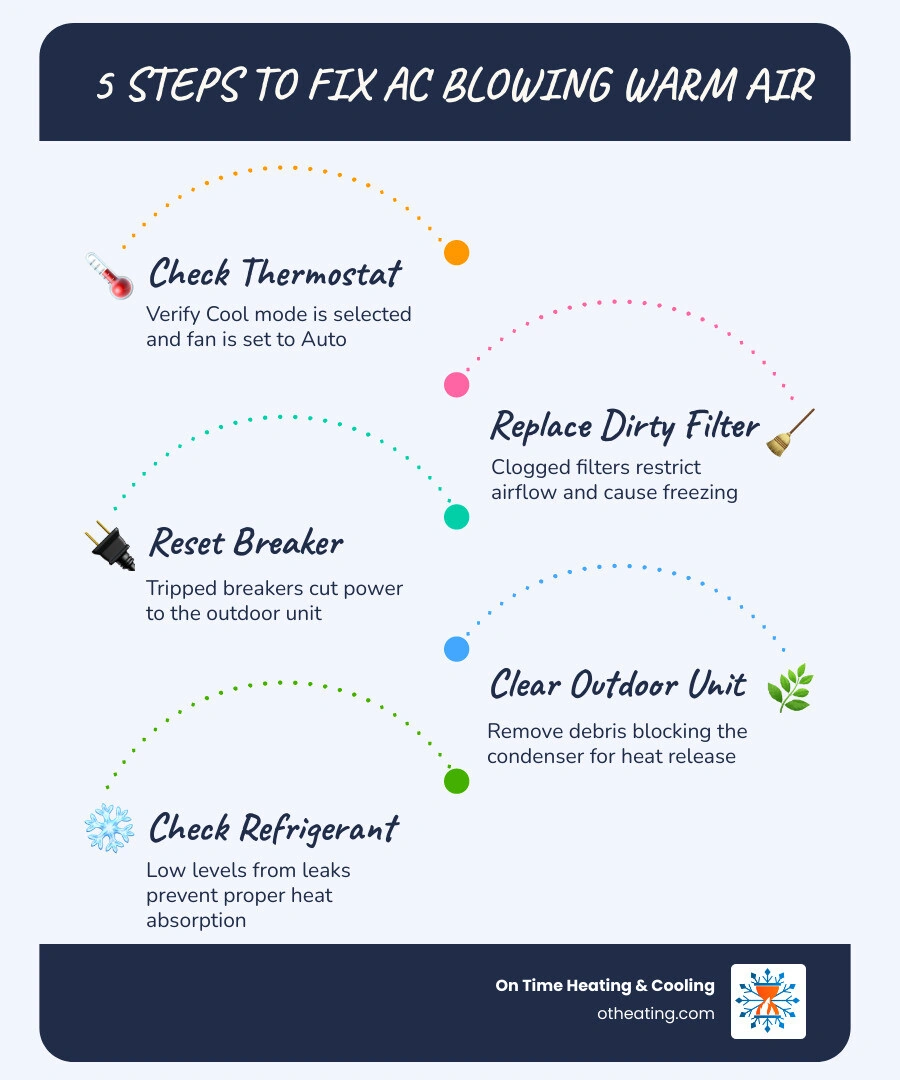
Quick look at why is my ac blowing warm air:
Why is my AC blowing warm air?

When you realize your home isn't getting cooler, the first question is naturally: why is my ac blowing warm air? In our experience serving Southeast Wisconsin, the answer usually falls into one of four categories: settings, airflow, power, or mechanical failure.
Understanding the Why Is My AC Blowing Warm Air? Troubleshooting Steps is the first step toward restoring comfort. Sometimes, the issue is as simple as a curious child or a guest bumping the thermostat into "Heat" mode. Other times, it’s a silent electrical issue where a circuit breaker has tripped, cutting power to the outdoor condenser while the indoor blower fan continues to push unconditioned air through your home.
Why is my AC blowing warm air due to a dirty filter?
It might seem minor, but a dirty air filter is the number one cause of system inefficiency and cooling failure. Statistics show that dirty filters can reduce system efficiency by up to 15%. When a filter is heavily clogged, it restricts the volume of air passing over the evaporator coils.
Without enough warm air to "bathe" the coils, the refrigerant inside them gets too cold, causing condensation to turn into ice. Once that ice forms, it acts as an insulator, preventing any heat exchange at all. This is often why homeowners notice Signs It's Time for AC Maintenance only after the system has completely stopped cooling.
Thermostat and Power Supply Issues
Your central air system actually relies on two separate power sources: one for the indoor furnace or air handler and another for the outdoor condenser unit. If the outdoor breaker trips, the indoor fan will still blow air, but because the outdoor unit isn't running to compress refrigerant, that air will be room temperature.
Additionally, thermostat issues account for up to 10% of reported warm air problems. Whether it's dead batteries causing the screen to go blank or an incorrect "Fan" setting, these are "user-error" fixes that don't require a toolbox. If your system won't respond to settings at all, you might be dealing with an AC Not Turning On scenario which requires checking your electrical panel.
Troubleshooting Steps 1-3: Thermostat, Filters, and Power
Before you panic, follow these first three steps. We've seen many cases where a simple 30-second check saved a homeowner from a service call fee.
Step 1: Check Thermostat Mode and Batteries
First, verify that your thermostat is set to "Cool" and the temperature is at least 3 to 5 degrees below the current room temperature.
Check the "Fan" setting as well. If it's set to "On," the blower will run 24/7, even when the AC isn't in a cooling cycle. This means it will circulate uncooled air through your house between cycles, making it feel like the AC Systems Blowing Warm Air in Brookfield is failing when it's actually just doing what it was told. Switch it to "Auto" so the fan only runs when the air is actually being cooled. Finally, if the screen is dim or blank, replace the batteries immediately.
Step 2: Inspect and Replace the Air Filter
Take a look at your air filter. If you can’t see light through it, or if it looks like a thick grey carpet of dust, it needs to go. In Wisconsin, we recommend checking your filter every 30 days during the peak of summer. A clean filter ensures 100% airflow efficiency.
A heavily clogged filter can drop airflow to 40% or less, leading to system strain and eventual failure. Incorporating this into your Preventative AC Maintenance routine is the easiest way to avoid mid-summer breakdowns.
Step 3: Check the Circuit Breaker
Go to your home’s electrical panel and look for the switches labeled "AC" or "Condenser." Sometimes a breaker can trip but look like it's still in the "On" position. Flip it all the way to "Off" and then back to "On."
If it trips again immediately, do not reset it a second time. This indicates a serious AC Electrical Connection Issues or a failing component that is drawing too much power. Repeatedly resetting a breaker can lead to an AC Circuit Breaker Keeps Tripping What It Means, which often points to a grounded compressor or a short circuit.
Troubleshooting Steps 4-5: Outdoor Units and Frozen Coils
If the basics are covered and you're still asking why is my ac blowing warm air, it’s time to head outside and look at the "heart" of your system.
Why is my AC blowing warm air because of a refrigerant leak?
Refrigerant is the lifeblood of your AC. Unlike the gas in your car, refrigerant isn't "used up"; it circulates in a closed loop. If your system is low, it means there is a leak.
Low refrigerant levels can cause the system to lose up to 20% of its cooling capacity. Signs of a leak include hissing or bubbling sounds near the lines, or ice forming on the copper refrigerant pipes. If you suspect a leak, you’ll need AC Refrigerant Leak Detection from a professional, as handling refrigerant requires EPA certification.
Step 4: Clear the Outdoor Condenser Unit
Your outdoor unit's job is to release the heat it gathered from inside your home. If the metal fins are clogged with cottonwood seeds, grass clippings, or overgrown bushes, the heat has nowhere to go. This causes the unit to overheat and eventually blow warm air as a protective measure.
Ensure there is a 2-foot "buffer zone" of clear space around the entire unit. You can gently rinse the coils with a garden hose (never use a power washer!), which can resolve up to 90% of outdoor unit issues. While you're there, check if the AC Drain Line Clogged is causing water to back up, which can also trigger a system shutdown.
Step 5: Check for Frozen Evaporator Coils
Go to your indoor unit (usually in the basement or a closet). If you see ice on the copper pipes or the unit itself, your coils are frozen.
- The Fix: Turn the AC "Off" at the thermostat but turn the Fan to "On." This helps thaw the ice.
- The Wait: It can take up to 24 hours for the ice to fully melt.
- The Warning: Do not try to scrape the ice off, as you could puncture the delicate coils.
| Issue | DIY Check | Professional Repair Needed? |
|---|---|---|
| Incorrect Settings | Check Thermostat Mode/Fan | No |
| Dirty Filter | Replace Filter | No |
| Tripped Breaker | Reset once | If it trips again |
| Refrigerant Leak | Look for ice/hissing | Yes (EPA Certified) |
| Failed Capacitor | Listen for humming | Yes |
| Clogged Drain | Use wet/dry vac | Recommended |
Preventing Warm Air with Regular Maintenance
The best way to answer the question of why is my ac blowing warm air is to make sure it never happens in the first place. Statistics show that regular AC Maintenance Keep System Running Smoothly can prevent up to 80% of common cooling issues.
The Benefits of Professional Tune-Ups
A professional tune-up isn't just a "look over." It involves cleaning the coils, testing the electrical capacitors (which are the most common parts to fail in the heat), and checking refrigerant levels.
Annual inspections can reduce the likelihood of major component failures, such as the compressor, by up to 50%. Our factory-trained technicians at On Time Heating & Cooling focus on punctuality and thoroughness, ensuring your system is ready for the humid Wisconsin July ahead.
Frequently Asked Questions
Should I turn off my AC if it is blowing warm air?
Yes, absolutely. If your AC is running but not cooling, the compressor—the most expensive part of your system—is likely straining itself. Continuing to run a malfunctioning system can lead to a total motor burnout or permanent compressor damage. Turn it off to protect your investment and prevent wasted energy.
How often should I change my air filter in Wisconsin?
As of May 2026, we recommend changing standard pleated filters every 30 to 90 days. However, if you live in areas like Brookfield or Menomonee Falls and have pets or high pollen counts, you should check them every month. High-efficiency filters (MERV 11 or higher) may last longer but require more frequent monitoring to ensure they aren't restricting airflow.
What is the difference between home and car AC troubleshooting?
While both use the refrigeration cycle, the scale and components differ. Car AC systems are much more prone to refrigerant leaks due to the constant vibration of driving. They also use different types of refrigerant and have cabin filters that are often neglected. For your home system, you have more DIY control over settings and outdoor unit cleanliness, whereas car AC issues almost always require specialized shop tools.
Conclusion
Discovering why is my ac blowing warm air doesn't have to be a nightmare. By following these five steps—checking your thermostat, filter, power, outdoor unit, and for ice—you can solve many common problems yourself.
However, if you've tried the basics and the air is still warm, it’s time to call in the experts. At On Time Heating & Cooling, we pride ourselves on being the punctual choice for Menomonee Falls, Waukesha, and the surrounding communities. Whether you need a quick repair or want to join our "On The Dot Club" for More info about AC services, we’re here 24/7 to bring the cool back to your home. Don't sweat through another Wisconsin summer—give us a call today!
Related Articles
 Maintenance
Melting the Mystery of Frozen AC Units
Fix ice forming on your ac unit causes and what to do. Learn how to defrost your system and prevent costly damage today.
Read Article Maintenance
How to Stop AC Running Constantly in Wisconsin Heat Waves
Discover why your AC runs constantly during Wisconsin heat waves and learn proven fixes to restore comfort and cut energy costs.
Read Article Maintenance
5 Common AC Repairs and What Causes Them
Discover the most common AC repairs and what causes them in Brookfield WI homes, plus DIY checks and repair-or-replace tips from local pros.
Read ArticleNeed HVAC help?
Whether you need a repair, maintenance, or a new installation, our expert team is here to help.