5 Common AC Repairs and What Causes Them
Discover the most common AC repairs and what causes them in Brookfield WI homes, plus DIY checks and repair-or-replace tips from local pros.
Shane Herro
Owner & Lead Tech

Discover the most common AC repairs and what causes them in Brookfield WI homes, plus DIY checks and repair-or-replace tips from local pros.
Why Knowing the Most Common AC Repairs and What Causes Them Can Save You a Costly Breakdown
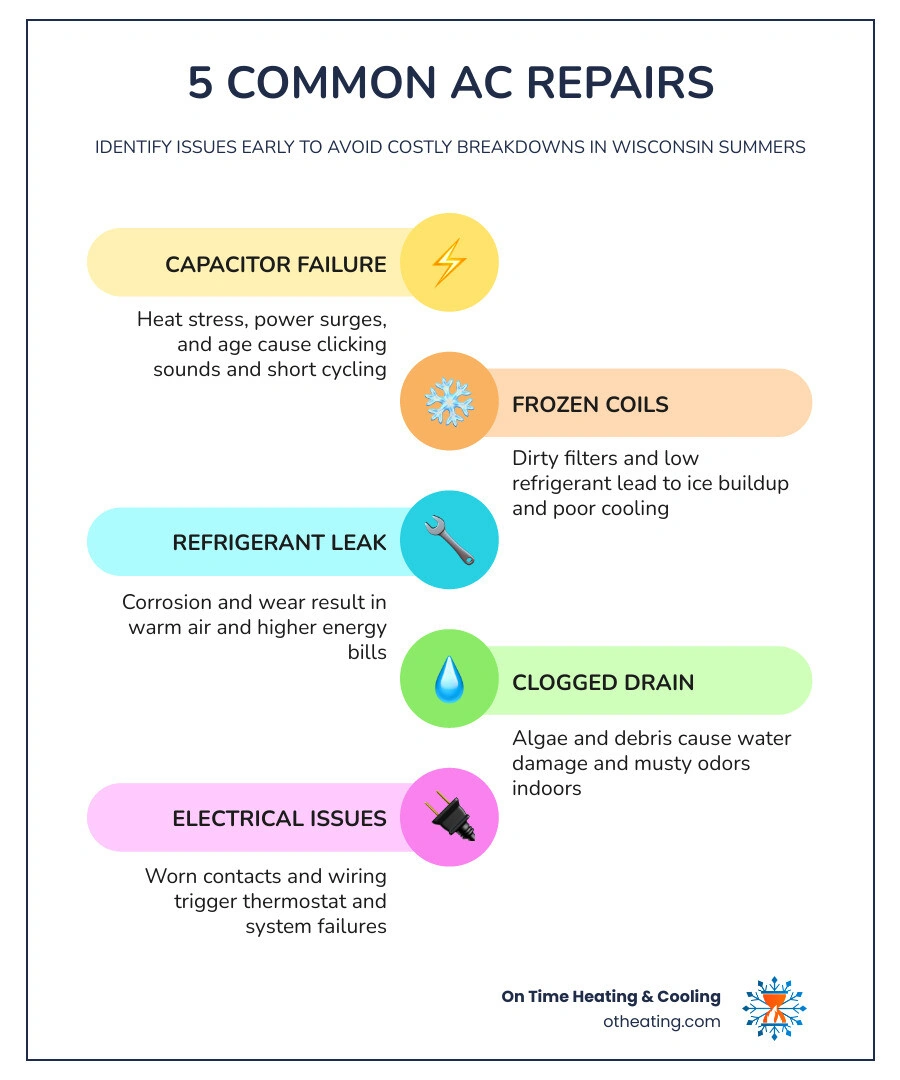
Understanding the most common AC repairs and what causes them is the first step to keeping your home cool and avoiding a sweaty surprise in the middle of a Wisconsin summer. Here's a quick overview:
Most Common AC Repairs and Their Causes
| Repair | Primary Cause |
|---|---|
| Capacitor replacement | Heat stress, power surges, age |
| Frozen evaporator coil | Dirty air filter, low refrigerant |
| Refrigerant leak | Corrosion, wear, improper installation |
| Clogged condensate drain | Algae and debris buildup |
| Electrical/thermostat failure | Worn contacts, wiring issues, dead batteries |
When your AC struggles on the hottest day of the year in Menomonee Falls or Brookfield, the cause is usually one of a handful of well-known problems. In fact, data from real service calls shows that bad capacitors alone account for more than one in five AC service calls — and nine out of ten central air units that aren't cooling properly trace back to a single, very fixable problem: a dirty air filter.
The good news is that most of these issues are predictable, preventable, and — when caught early — affordable to fix. We walk you through the five most common AC repairs, what triggers them, and how to spot warning signs before a small problem becomes a big one.
Understanding the Most Common AC Repairs and What Causes Them
An air conditioning system is a complex machine. It relies on a delicate balance of electrical power, precise airflow, and chemical refrigerant cycles to pull heat out of your home and release it outdoors. When one piece of this puzzle fails, the entire system can grind to a halt.
In Southeast Wisconsin, our systems undergo intense seasonal stress. We go from freezing winters where the outdoor unit sits idle under heavy snow to humid, sweltering summers where the compressor must run almost continuously. This dramatic shift places unique demands on local cooling systems.
To help you understand what goes on behind the metal grilles of your outdoor condenser and indoor air handler, we have broken down the most common AC repairs and what causes them in the table below:
| Common AC Issue | Primary Root Cause | Key Warning Signs | Prevention Strategy |
|---|---|---|---|
| Failed Capacitor | Heat stress, electrical surges, age | Clicking or humming sounds, slow-starting fan, warm air | Annual electrical testing during spring tune-ups |
| Frozen Evaporator Coil | Restricted airflow (dirty filter), low refrigerant | Ice buildup on refrigerant lines, weak airflow, constant running | Changing air filters every 30 to 90 days |
| Clogged Condensate Drain | Algae, mold, and dust buildup | Water pooling around indoor unit, musty odors, system shutoff | Regular drain line flushing with vinegar |
| Refrigerant Leak | Vibration friction, formicary corrosion | Hissing noises, ice on coils, AC running but not cooling | Annual professional leak inspections |
| Contactors and Relay Failures | Electrical wear, insect intrusion, pitting | AC won't turn off, humming noises, outdoor unit won't start | Professional contact cleaning and inspections |
By understanding these relationships, you can catch small, silent issues before they leave you stranded in a hot house.
Identifying the Most Common AC Repairs and What Causes Them in Electrical Systems
Your air conditioner's electrical system is its central nervous system. When electrical components fail, the system either refuses to start or runs so inefficiently that it puts other expensive parts at risk.
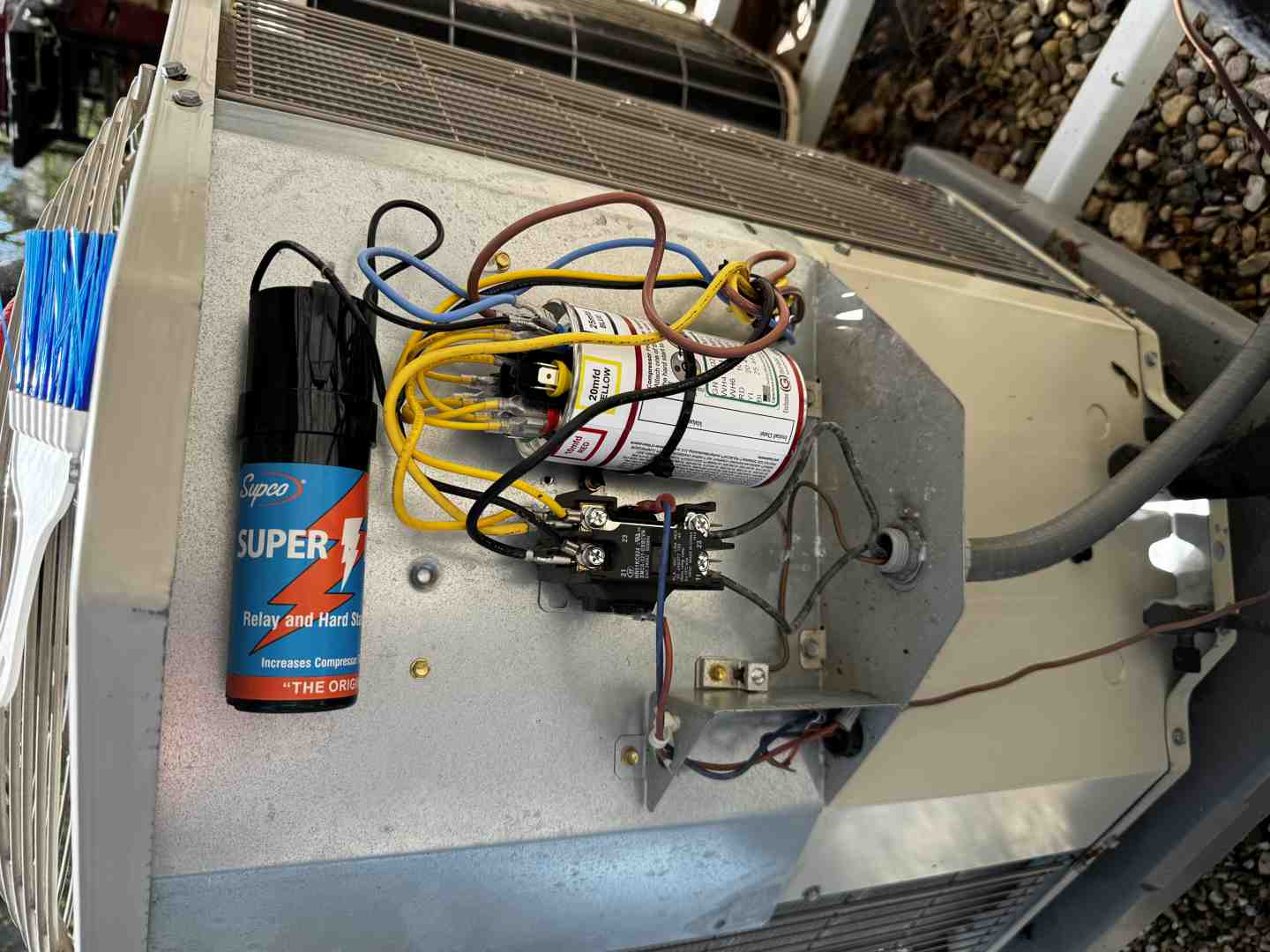
The Run Capacitor: The AC's "Battery Booster"
By far, the most frequent electrical failure in any central air conditioner is a bad run capacitor. In fact, real-world service data shows that failing capacitors account for 21.5% of all emergency AC repair calls.
Think of the capacitor as a temporary storage battery. Your AC's compressor and outdoor fan motor require a massive jolt of electrical energy to break physical inertia and start spinning. The capacitor stores this energy and delivers it precisely when the system cycles on.
- What Causes Capacitor Failure? The main culprits are heat stress and power surges. During peak summer, temperatures inside the outdoor unit's electrical cabinet can soar. This extreme heat degrades the capacitor’s internal chemical layers. Additionally, minor power fluctuations—common during summer storms in Waukesha or New Berlin—can instantly fry a capacitor's delicate internal components.
- The Warning Signs: If you hear a distinct clicking or loud humming sound from your outdoor unit but the fan isn't spinning, your capacitor has likely failed. If ignored, the fan motor or the compressor will attempt to start without this necessary electrical boost. This causes the motors to overheat rapidly, which can lead to total motor burnout.
- The Chain Reaction: Ignoring a weak capacitor is one of the quickest ways to destroy your compressor. When a compressor must work harder to start, it suffers intense mechanical wear. This is why we always check capacitor capacitance levels during our seasonal tune-ups to catch them before they fail completely.
To learn more about identifying these electrical red flags, check out our guide on Signs Your AC Needs Repair. If you are worried that your compressor might already be suffering from electrical strain, read our breakdown of Why Your AC Compressor Is Failing.
Airflow Restrictions: The Most Common AC Repairs and What Causes Them
Your air conditioner does not actually "create" cold; it removes heat from your indoor air. To do this, a high volume of warm indoor air must constantly blow across the cold evaporator coil. If this airflow is restricted, the entire thermodynamic process collapses.
The Frozen Evaporator Coil
When homeowners see ice forming on their outdoor copper lines or indoor evaporator coil on a humid summer day in Delafield or Sussex, they are often confused. How can a system freeze up when it is hot outside?
- The Physics of a Freeze: The refrigerant flowing through your indoor evaporator coil is incredibly cold. Under normal circumstances, the warm air blowing from your return vents warms the coil, allowing the refrigerant to absorb that heat and carry it outside. If that warm airflow is restricted, the moisture in your home’s air will condense on the freezing coil and instantly turn to ice. Once a thin layer of ice forms, it acts as an insulator, blocking what little airflow remained and causing the entire coil to freeze into a solid block of ice.
- What Causes Restricted Airflow? In nine out of ten cases, the root cause is a simple, heavily neglected air filter. A dirty air filter acts as a solid wall, choking off the system’s air supply. Other causes include closed supply registers, blocked return vents, or a failing indoor blower motor.
- The Hidden Danger: Running a system with a frozen coil can cause liquid refrigerant to flood back into the compressor. Compressors are designed to compress gas, not liquid. If liquid refrigerant enters the compressor chamber, it can cause immediate, catastrophic mechanical failure.
If your system is beginning to show signs of frost, turn it off immediately and read our dedicated article on AC Freezing Up to learn how to thaw it safely. For a broader look at how airflow impacts your home's comfort, explore our resource on Exploring Common AC Problems and Solutions.
Drainage and Refrigerant Issues in Southeast Wisconsin Homes
Water and chemical refrigerant are the two primary fluids moving through your cooling system. When either of these flows is disrupted, you face a high risk of property damage or system failure.
Clogged Condensate Drain Lines
As your AC cools your home, it also dehumidifies it. In humid climates like ours in Southeast Wisconsin, an air conditioner can pull gallons of water out of the air every single day. This water collects in a drain pan beneath the indoor coil and flows outside through a narrow condensate drain line.
- What Causes Clogs? The dark, damp environment inside your AC's drain line is the perfect breeding ground for algae, mold, and bacterial slime. Over time, this biological growth combines with household dust to form a thick clog.
- The Consequences: Once blocked, the water has nowhere to go but back up into the drain pan. If your system does not have a safety float switch installed, the water will overflow, causing expensive water damage to your ceilings, drywall, and nearby electrical components. It can also lead to mold growth inside your walls.
To protect your home from water damage, read our complete guide on AC Drainage Problems in Homes.
Refrigerant Leaks and the EPA Regulations
Your air conditioner's refrigerant system is a closed, sealed loop. It should never "consume" or "lose" refrigerant like a car loses motor oil. If your system is low on refrigerant, you have a leak.
- What Causes Leaks? Over years of operation, the constant vibration of the system can cause copper lines to rub against each other or the system's metal frame, wearing tiny holes in the metal. Additionally, formicary corrosion—caused by common household chemical vapors interacting with copper—can create microscopic pinhole leaks in your coils.
- The Environmental and Regulatory Impact: Refrigerant handling requires strict EPA Section 608 certification because these chemical compounds can be harmful to the environment. Furthermore, old R-22 refrigerant (commonly found in systems installed before 2010) has been completely phased out. As of June 2026, sourcing R-22 is incredibly difficult and expensive, making even minor leaks in older systems a primary reason to consider a full system replacement. Modern systems use more environmentally friendly alternatives like R-410A or the newer R-32.
If your system is running constantly but only blowing lukewarm air, a leak could be the issue. Learn more by reading Why Is My AC Blowing Warm Air?.
Safe DIY Checks Before Calling a Professional
Before you pick up the phone to book an emergency service call, there are a few safe, simple checks you can perform. Taking ten minutes to run through this checklist can save you from paying for a professional diagnostic visit for a simple issue like a flipped switch.
1. Inspect the Thermostat
It sounds simple, but a surprising number of "broken" air conditioners are just suffering from thermostat issues.
- Check the Batteries: If your thermostat screen is blank or flashing a low-battery icon, replace the batteries immediately.
- Verify the Settings: Ensure the thermostat is set to "Cool" and the fan is set to "Auto" rather than "On" (which blows air continuously even when the system isn't cooling). Set the temperature at least three degrees below the current room temperature to trigger a cooling cycle.
2. Check Your Air Filter
If your AC is running but blowing weak, lukewarm air, pull the air filter out.
- The Light Test: Hold the filter up to a light source. If you cannot see light passing through the fibers, the filter is completely clogged and must be replaced.
- Turn It Off to Thaw: If you notice ice on the indoor or outdoor lines, turn the system completely off at the thermostat but keep the fan setting on "On." This will blow warm air over the frozen coil to thaw it out safely before a technician arrives.
3. Check the Circuit Breakers
Air conditioners draw a lot of power, especially on hot days when the electrical grid is strained.
- Locate Your Electrical Panel: Check both the indoor electrical panel and the outdoor disconnect box near your condenser unit.
- Reset Once: If you find a tripped breaker, flip it completely to the "Off" position, then back to "On." Crucial Safety Warning: If the breaker trips again immediately, do not reset it a second time. A repeatedly tripping breaker indicates a severe electrical short or a locked compressor motor. Forcing it to reset can cause an electrical fire or destroy your system's compressor.
4. Clear the Outdoor Condenser
Your outdoor unit needs room to breathe to release the heat it pulled from your home.
- Clear Debris: Ensure there are at least two feet of clear space around the outdoor unit. Cut back any tall grass, weeds, or shrubs.
- Clean the Coils: If the metal fins of your outdoor unit are caked in lawn clippings, cottonwood seeds, or dirt, gently spray the unit with a garden hose (never use a high-pressure power washer, which can bend the delicate aluminum fins).
For a complete step-by-step troubleshooting path, check out our AC Troubleshooting Tips Before Calling a Pro.
Repair vs. Replace: Navigating the $5,000 Rule
When you are faced with a major component failure—such as a burnt-out compressor or a severely leaking evaporator coil—you have to make a tough choice: do you invest in repairing your current unit, or is it time to replace the entire system?
To help our neighbors in Pewaukee, Hartland, and Oconomowoc make this decision with confidence, we recommend using the $5,000 Rule.
How the $5,000 Rule Works
This simple formula combines the age of your system with the estimated cost of the repair to evaluate the long-term value of your investment:
$$text{Age of System (Years)} times text{Estimated Repair Cost} = text{Decision Index}$$
- If the result is under $5,000: It is generally highly cost-effective to perform the repair, especially if your system has a solid maintenance history and is still under warranty.
- If the result is over $5,000: The system is likely nearing the end of its reliable lifespan. Investing a significant amount of money into an aging unit often leads to "throwing good money after bad," as other old components are likely to fail shortly after.
Other Critical Factors to Consider
- Refrigerant Type: If your system was installed before 2010 and runs on phased-out R-22 refrigerant, any repair that involves opening the refrigerant loop (such as fixing a leak or replacing a coil) is rarely worth the investment. Upgrading to a modern, high-efficiency system using current refrigerants is almost always the smarter financial decision.
- System Lifespan: A typical central air conditioner in Southeast Wisconsin lasts between 12 and 15 years. Once a unit crosses the 12-year mark, its mechanical efficiency drops, and its components face severe wear.
- Energy Efficiency and SEER2 Ratings: Modern air conditioners are significantly more energy-efficient than systems built just a decade ago. Upgrading an old, low-efficiency unit to a modern system can reduce your summer cooling bills by 20% to 40%, helping the new system pay for itself over time.
For more guidance on navigating this choice, read our comprehensive resource on Common AC Problems.
Frequently Asked Questions About AC Repairs
We believe in empowering our customers with clear, honest answers. Here are some of the most common questions we hear from homeowners in Waukesha County and the surrounding areas.
Why is my AC running but not blowing cold air?
This is one of the most common issues we encounter. If your system is turned on and blowing air through your vents, but that air is warm or lukewarm, the problem usually points to one of four common issues:
- A Clogged Air Filter: This restricts airflow so severely that the air cannot be properly cooled.
- Dirty Condenser Coils: If the outdoor unit is covered in dirt, grass clippings, or cottonwood seeds, it cannot release the heat it absorbed from your home, leaving the air inside warm.
- A Failed Capacitor: The outdoor fan or compressor may not be running, meaning no cooling cycle is actually occurring.
- Low Refrigerant: A leak in your lines means there is not enough chemical refrigerant to absorb and transport heat out of your home.
How often should I change my home's air filter in Southeast Wisconsin?
As a general rule, we recommend checking your air filter every 30 days and replacing it at least every 90 days. However, your specific schedule depends on your household dynamics:
- Every 30 Days: If you have pets (especially shedding dogs or cats), family members with severe allergies or asthma, or if you live in a high-dust area (such as near active construction or agricultural fields in Lannon or Sussex).
- Every 60 Days: For standard suburban homes with average occupancy and no indoor pets.
- Every 90 Days: For single occupants, homes without pets, or vacation properties that see minimal daily use.
What are the risks of ignoring a clicking sound from my AC unit?
A persistent clicking sound when your air conditioner tries to start is a clear warning sign of an electrical struggle. It usually indicates a failing run capacitor or a worn-out electrical contactor.
If you ignore this sound, the electrical components will continue to degrade. This forces your compressor and fan motors to draw excessive electrical current to start up. Over time, this intense electrical stress will burn out your fan motor or, worse, cause your expensive compressor to fail entirely. Addressing a simple clicking sound early can prevent a major, costly system breakdown.
Conclusion
When your air conditioner runs smoothly, it is easy to take your indoor comfort for granted. But when summer temperatures rise in Southeast Wisconsin, having a reliable cooling system is essential for your family's health and comfort.
At On Time Heating & Cooling, we are proud to serve homeowners across Menomonee Falls, Waukesha, Brookfield, Delafield, Sussex, Pewaukee, New Berlin, Oconomowoc, Lannon, and the surrounding areas. We have built our reputation on a simple promise: punctuality, old-school customer service, and modern technical expertise. Our factory-trained technicians are dedicated to getting your system back up and running quickly and correctly.
Why Choose On Time Heating & Cooling?
- Commitment to Punctuality: We respect your busy schedule. When we promise a service window, we arrive on time, every time.
- Transparent Service: We believe in honest, clear communication. We will diagnose your issue, explain the root cause, and present your options clearly.
- Free Second Opinions: Got a major repair diagnostic from another company? We offer free second opinions to ensure you are getting the right solution for your home.
- The On The Dot Club: Protect your home year-round with our premier membership plan, offering regular system tune-ups, priority service, and exclusive discounts.
If your air conditioner is blowing warm air, making strange noises, or simply overdue for its annual safety check, do not wait for a complete system breakdown. Explore our guide on Common AC Problems or reach out to our friendly team today to schedule your professional cooling service!
Related Articles
 Maintenance
Melting the Mystery of Frozen AC Units
Fix ice forming on your ac unit causes and what to do. Learn how to defrost your system and prevent costly damage today.
Read Article Maintenance
How to Stop AC Running Constantly in Wisconsin Heat Waves
Discover why your AC runs constantly during Wisconsin heat waves and learn proven fixes to restore comfort and cut energy costs.
Read Article Maintenance
How Duct Cleaning Prevents Mold in Your HVAC System
Learn how duct cleaning prevents mold growth in your hvac system with professional service in Southeast Wisconsin.
Read ArticleNeed HVAC help?
Whether you need a repair, maintenance, or a new installation, our expert team is here to help.