How Duct Cleaning Prevents Mold in Your HVAC System
Learn how duct cleaning prevents mold growth in your hvac system with professional service in Southeast Wisconsin.
Shane Herro
Owner & Lead Tech

Learn how duct cleaning prevents mold growth in your hvac system with professional service in Southeast Wisconsin.
Why Duct Cleaning Is Your First Defense Against HVAC Mold
Understanding how duct cleaning prevents mold growth in your HVAC system starts with one uncomfortable fact: the average American spends about 90% of their time indoors, breathing air that can be up to five times more polluted than the air outside. When mold takes hold inside your ductwork, your HVAC system stops being a comfort tool and starts acting as a spore distribution network — pushing contaminated air into every room of your home, around the clock.
For homeowners in Menomonee Falls and across Southeast Wisconsin, humid summers and variable indoor conditions create the perfect environment for mold to quietly establish itself deep inside ductwork — long before you ever notice a musty smell or a dark stain near a vent.
Here is how duct cleaning prevents mold growth in your HVAC system:
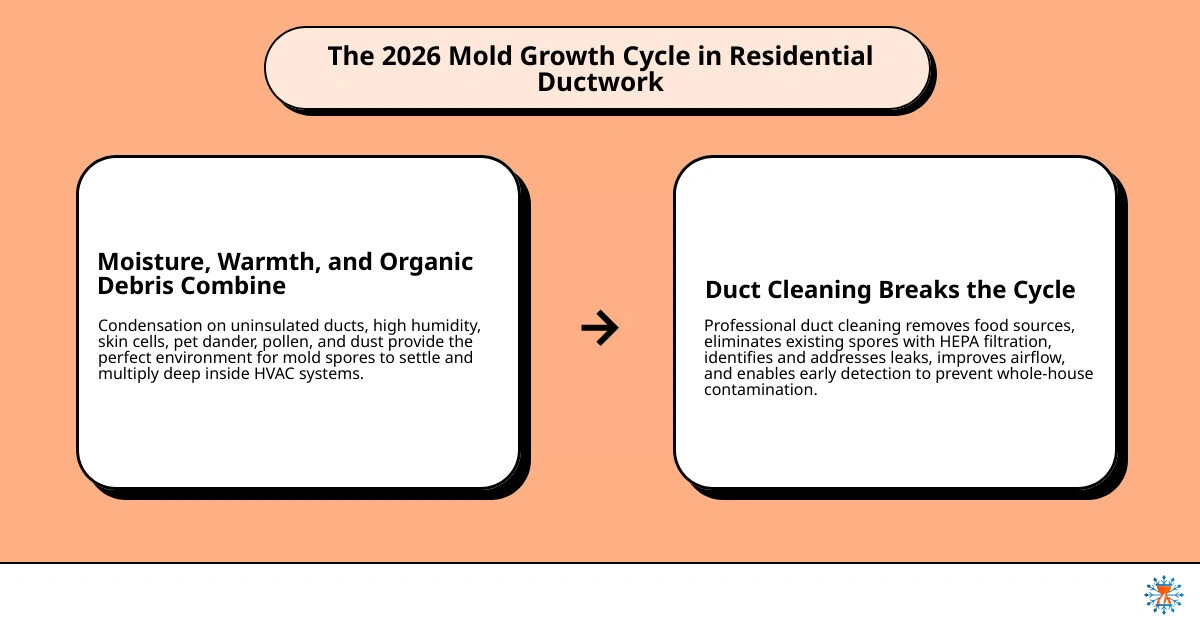
- Removes food sources — Dust, skin cells, pet dander, and pollen that accumulate in ducts give mold the organic material it needs to thrive
- Reduces moisture buildup — Cleaning allows technicians to identify and address condensation, leaks, and drainage problems that create damp conditions
- Eliminates existing spores — Professional HEPA-filtered equipment captures particles as small as 0.3 microns, including active mold spores
- Improves airflow — Restored airflow reduces the stagnant, humid pockets where mold colonies form
- Enables early detection — A thorough cleaning gives technicians a clear view of the system, catching moisture problems before they become a full mold infestation
- Prevents whole-house spread — Cleaning with negative air pressure containment stops spores from being redistributed into your living spaces during the process
The key principle is this: mold needs three things to grow — moisture, warmth, and something to feed on. Your air ducts can quietly provide all three. Duct cleaning directly disrupts that cycle.
Understanding the Causes of HVAC Mold in Southeast Wisconsin
In our neck of the woods—from the lakeside humidity of Mequon to the inland temperatures of Oconomowoc—mold growth in HVAC systems is almost always a story about moisture. Mold spores are naturally occurring and enter our homes through open windows, on our clothing, or even on our pets. However, these spores only become a problem when they find a hospitable place to land and grow.
The primary culprits are moisture sources such as leaking roofs, plumbing drips, or, most commonly, condensation. When warm, humid air from a Wisconsin summer hits the cold metal surface of your air ducts, it "sweats." This condensation provides the drink of water mold needs to begin its life cycle. If your ducts are uninsulated and located in a crawlspace or attic, this risk increases significantly.
Identifying the Signs of Mold Growth in Your Air Duct System is the first step in protecting your home. Often, the moisture is hidden behind the scenes, caused by a clogged condensate drain line or a cracked drain pan that allows standing water to sit inside your air handler. Over time, this moisture migrates into the ductwork, turning your ventilation into a greenhouse for microbial growth.

How duct cleaning prevents mold growth in your hvac system by removing food sources
If moisture is the "drink," then dust is the "buffet." Many people don't realize that the "dust" in their homes is largely comprised of organic materials like skin cells, pet dander, and pollen. These materials are exactly what mold feeds on.
When we perform Air Duct Cleaning and Mold Removal, we aren't just getting rid of the gray fuzz you see on a vent; we are removing the entire ecosystem. Mold has biological "roots" known as hyphae that can weave through layers of dust. By physically removing this debris, we eliminate the food source, making it nearly impossible for new spores to take hold even if a little moisture is present.
The Professional Process: How Duct Cleaning Prevents Mold Growth in Your HVAC System
You might be tempted to stick a vacuum hose down your vent and call it a day, but true prevention requires a professional touch. At On Time Heating & Cooling, we follow rigorous industry standards, including those set by NADCA (National Air Duct Cleaners Association) and the IICRC S520 guidelines for mold remediation.
The process begins with creating negative air pressure. We connect a high-powered, HEPA-filtered vacuum system to your main trunk line. This ensures that as we agitate the dust and debris inside your vents, everything is pulled directly into our containment system rather than being blown into your living room in New Berlin or Brookfield.
Next, we use mechanical agitation tools—specialized brushes and air whips—to scrub the interior walls of your ducts. This is a critical part of our Professional Duct Cleaning Services. It ensures that even the stubborn, sticky layers of dust (where mold loves to hide) are dislodged and removed.
Why moisture control is the key to mold prevention
Cleaning is only half the battle; the other half is making sure the mold doesn't come back. The EPA and other health organizations emphasize that the key to mold control is moisture control. If you have a water leak or a flood, you have a 24-48 hour drying window to prevent mold from starting.
We recommend keeping your indoor humidity levels below 50%. In Southeast Wisconsin, this often requires a whole-home dehumidifier or ensuring your AC system is properly sized to remove moisture. During our cleaning process, we look for "hot spots" of moisture. Our technicians can help you understand Mold Remediation and Duct Cleaning strategies, such as using a hygrometer to monitor humidity or sealing leaky ducts that might be pulling in damp air from a basement or attic.
Identifying When Your System Needs Immediate Attention
How do you know if your system is already in trouble? The most common sign is a musty, "earthy," or "wet sock" smell that only appears when the fan turns on. This happens because the air passing over the mold colonies picks up odors and spores, distributing them throughout the house.
Another visual cue is the presence of dark particulate staining around your supply registers. This "ghosting" or "smudging" often indicates that the air coming out of your vents is heavily laden with debris or microbial growth. Understanding How Clean Ducts Improve Indoor Air Quality is vital here; if you see these signs, your system is actively working against your health.
For many families in Waukesha or Menomonee Falls, the first sign isn't a smell or a sight, but a physical symptom. Unexplained allergy flare-ups, persistent coughing, or watery eyes that seem to improve when you leave the house are major red flags that your HVAC system may be contaminated.
Risks of ignoring mold in fiberglass or insulated ducts
There is a significant difference between mold on sheet metal and mold on porous materials. If your system uses fiberglass duct board or has internal fiberglass insulation (liner), mold can penetrate deep into the fibers.
According to our Air Duct Cleaning Complete Guide, porous materials that become moldy generally cannot be effectively cleaned. In these cases, the contaminated insulation must be removed and replaced. Ignoring this can lead to a never-ending cycle of regrowth, as the mold "roots" remain protected deep within the material. This is one of the primary reasons Why Air Duct Cleaning Improves Health—it identifies these high-risk areas before they cause long-term respiratory issues.
Long-Term Strategies for a Mold-Free Home in 2026
Once your system is clean, the goal is to keep it that way. In 2026, we have more tools than ever to maintain a healthy home environment. One of the most effective additions is the installation of UV-C germicidal lights. These lights are typically installed near the evaporator coil—the dampest part of your HVAC system. The UV light "zaps" the DNA of mold and bacteria, preventing them from ever forming a colony.
High-quality filtration is another pillar of prevention. Upgrading to MERV 13 filters can help trap mold spores before they ever enter your ductwork. However, thicker filters need to be changed more frequently—usually every 60 to 90 days—to ensure they don't restrict airflow and cause the system to freeze up, which creates even more moisture!
Maintaining the Importance of Regular Air Duct Cleaning every 3 to 5 years ensures that dust never reaches the "critical mass" needed to support a mold colony. Whether you are in Sussex or Germantown, regular check-ups are the best way to catch small issues before they become expensive remediation projects. We've seen How Dirty Air Ducts Impact Health in Sussex, and a proactive approach is always the safest bet.
How duct cleaning prevents mold growth in your hvac system through early detection
When our factory-trained technicians perform a cleaning, they are also performing a deep-tissue inspection of your home's "lungs." We check the drain pans for standing water, ensure the condensate line is flowing freely, and look for disconnected duct joints that might be sucking in humid, unconditioned air.
These Air Duct Cleaning Benefits for Your Home go beyond just cleanliness. By optimizing airflow and ensuring all components are dry and sealed, we remove the "warmth and moisture" variables from the mold equation. A well-maintained system is a dry system, and a dry system is a mold-free system.
Frequently Asked Questions about HVAC Mold Prevention
Can I use bleach to clean mold out of my ducts?
We strongly advise against this. Bleach is mostly water; while it might kill mold on the very surface of a non-porous material, the water can soak into surrounding areas and actually encourage regrowth. Furthermore, bleach fumes are caustic and can be circulated throughout your home by the HVAC system. Professionals use EPA-approved antimicrobial treatments specifically designed for HVAC use that are much safer and more effective.
How often should I have my ducts cleaned to prevent mold?
For most homes in Southeast Wisconsin, a professional cleaning every 3 to 5 years is the standard. However, you should consider a cleaning sooner if you have recently completed a home renovation (which creates massive amounts of organic dust), if you have experienced any water damage or leaks, or if someone in your home suffers from severe asthma or allergies.
Does duct cleaning remove the smell of mold?
Yes! By removing the source of the odor—the mold colonies and the organic debris they feed on—the "musty" smell is typically eliminated. For persistent odors, we can also provide whole-system sanitization that neutralizes Volatile Organic Compounds (VOCs) and leaves your home smelling fresh and clean.
Conclusion
At On Time Heating & Cooling, we believe that your home should be a sanctuary of health and comfort. Our commitment to punctuality and our factory-trained expertise means that when you trust us with your home, you are getting the best care in Southeast Wisconsin. From Menomonee Falls to Pewaukee, we are here 24/7 to ensure your air is clean, dry, and mold-free.
If you're concerned about your indoor air quality or want to schedule a preventative cleaning, don't wait for the musty smells to start. Contact us today for our Professional Duct Cleaning Services and breathe easier knowing your HVAC system is protected.
Related Articles
 Maintenance
Melting the Mystery of Frozen AC Units
Fix ice forming on your ac unit causes and what to do. Learn how to defrost your system and prevent costly damage today.
Read Article Maintenance
How to Stop AC Running Constantly in Wisconsin Heat Waves
Discover why your AC runs constantly during Wisconsin heat waves and learn proven fixes to restore comfort and cut energy costs.
Read Article Maintenance
5 Common AC Repairs and What Causes Them
Discover the most common AC repairs and what causes them in Brookfield WI homes, plus DIY checks and repair-or-replace tips from local pros.
Read ArticleNeed HVAC help?
Whether you need a repair, maintenance, or a new installation, our expert team is here to help.