

%202%20(1).svg)
.svg)

To Fix or To Flip Your HVAC System
Written by
On Time Heating & Cooling
Published on
May 27, 2026
Should I Repair or Replace My HVAC System? Here's How to Decide Fast
Should I repair or replace my HVAC system is one of the most stressful questions a homeowner can face — especially when your heat goes out on a cold Menomonee Falls, WI morning or your AC quits in the middle of July.
The short answer depends on a few key factors:
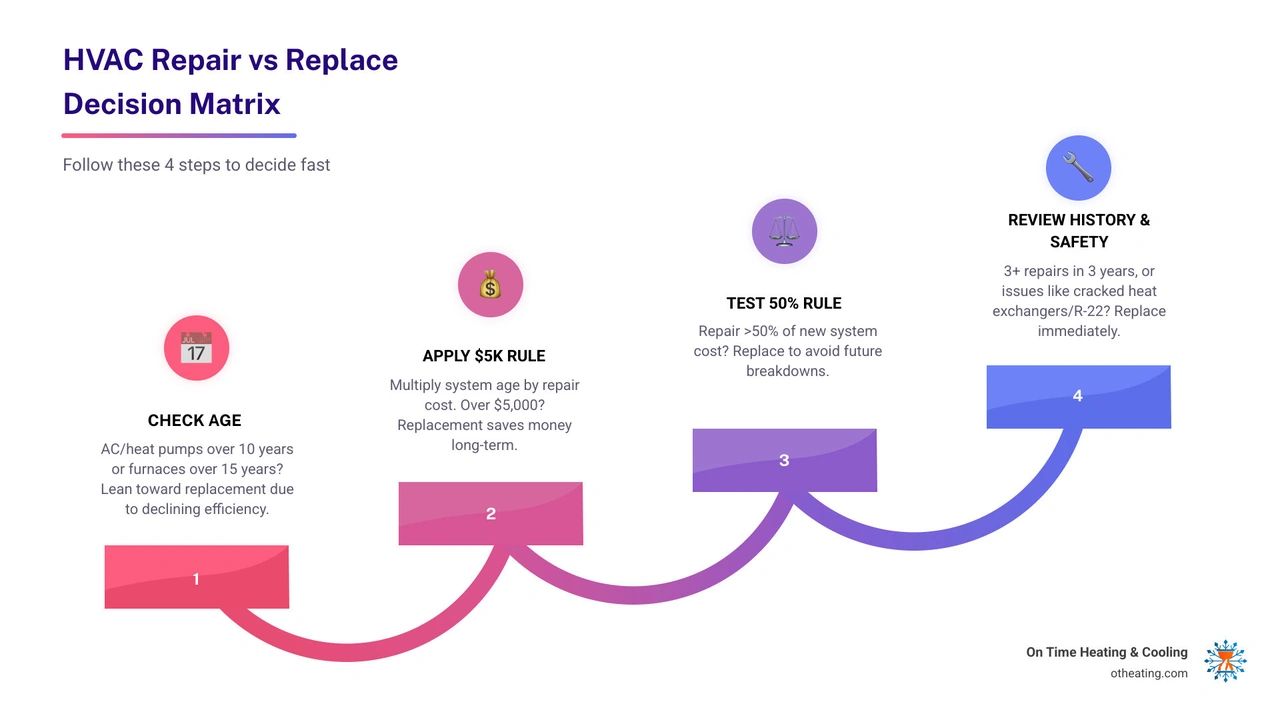
- Age of your system — AC and heat pumps over 10 years old, or furnaces over 15 years old, lean toward replacement
- The $5,000 rule — Multiply your system's age by the repair cost; if the result is over $5,000, replacement is usually smarter
- The 50% rule — If the repair costs more than half of what a new system would cost, replace it
- Repair history — Three or more repairs in the last three years is a strong signal to replace
- Safety issues — Cracked heat exchangers, gas leaks, or carbon monoxide risks mean replace immediately
- R-22 refrigerant — If your system still uses this phased-out refrigerant, replacement is almost always the better move
When none of those flags apply — your system is under 10 years old, the issue is minor, and repairs are infrequent — fixing it is usually the right call.
Making the wrong choice can cost you thousands. Repair too aggressively on an aging system and you're throwing money into a unit that's already on its last legs. Replace too early and you leave real value on the table. The goal of this guide is to help you make a clear, confident call — without the guesswork.
The Financial Framework: Should I Repair or Replace My HVAC System?
When we visit homes in Waukesha or Brookfield, we often find homeowners stuck between two instincts: the desire to save money today by repairing, and the need to avoid a "money pit" system that breaks down every season. To take the emotion out of the decision, we use a few data-driven rules.
The 50% Rule
This is one of the simplest benchmarks in the industry. If a repair quote comes back and the total is more than 50% of the cost of a brand-new system, we almost always recommend a replacement. Why? Because an older system that requires a massive investment likely has other components — like the blower motor or control board — that are also nearing the end of their lives. Investing half the cost of a new unit into a system with no warranty is a high-risk gamble.
The $5,000 Rule
As of April 2026, the "$5,000 Rule" remains a gold standard for homeowners. You simply multiply the age of the unit by the cost of the repair.
- Example A: A 12-year-old AC needs a $600 repair. (12 x 600 = 7,200). Since 7,200 is greater than 5,000, you should consider replacement.
- Example B: A 5-year-old furnace needs that same $600 repair. (5 x 600 = 3,000). Since 3,000 is less than 5,000, it is usually worth the fix.
Repair Frequency and Investment Value
Think of your HVAC system like a car. One flat tire (a blown capacitor) is no big deal. But if you’re in the shop every three months for engine trouble, the "domino effect" has likely begun. If you’ve had three or more significant repairs in the last three years, your system is telling you it's tired. At this point, you aren't just paying for parts; you're paying for the "hidden tax" of inefficiency and the stress of wondering if it will last through the next Wisconsin cold snap.
When Choosing Between Furnace Repair and Replacement, it’s vital to look at the repair history. A clean history makes a one-off repair more palatable. However, if you are constantly searching for Furnace Repair or Furnace Replacement advice, it's a sign that your investment value is plummeting.
Evaluating System Age and Component Lifespans
Age isn't just a number; it’s a measure of systemic fatigue. In our corner of Southeast Wisconsin, our systems work hard. Our furnaces battle sub-zero winters, and our ACs fight through humid summers. This heavy workload impacts how long components last.
Generally, HVAC equipment follows these average lifespans:
| Component | Average Lifespan | Replacement Threshold |
|---|---|---|
| Central Air Conditioner | 15–20 Years | 10–12 Years (if inefficient) |
| Gas Furnace | 15–20 Years | 15 Years |
| Heat Pump | 15 Years | 10 Years |
| Boilers | 20+ Years | 15–20 Years |
When to repair my HVAC system for minor issues
Not every breakdown is a death knell. In fact, many common issues are "wear items" that are expected to fail once or twice during a system's life. If your system is under 10 years old and experiences the following, we usually suggest a repair:
- Capacitor Replacement: These are essentially small batteries that start your motors. They fail often due to heat but are inexpensive to fix.
- Contactor Wear: This is a simple switch that tells your outdoor unit to turn on.
- Thermostat Calibration: Sometimes the "broken" AC is just a thermostat that needs new batteries or a settings update.
- Sensor Cleaning: Flame sensors in furnaces often just need a professional cleaning to get the system back up and running.
If you are looking for HVAC Replacement Delafield WI, but your system only has a minor electrical glitch, we will always be honest and tell you a repair is the better path.
Major component failures that signal replacement
On the flip side, some failures are "catastrophic," meaning the labor and part costs are so high that repair is rarely logical for an older unit.
- Compressor Failure: The "heart" of your AC. If this goes out on a unit over 10 years old, replacement is almost always the answer.
- Cracked Heat Exchanger: This is a major safety hazard. A crack can leak carbon monoxide into your home. Because of the danger and the massive labor required to replace it, a new furnace is usually required.
- Evaporator Coil Leaks: If your coil is leaking refrigerant and the unit is old, you’re looking at a very expensive fix that might not even hold.
For those considering HVAC Replacement Waukesha WI, these major failures are the most common reasons homeowners finally decide to upgrade.
Efficiency, Safety, and the R-22 Factor
Modern technology has moved fast. If your system was installed before 2015, it is likely significantly less efficient than what is available today.
In 2026, we look at several efficiency metrics:
- SEER2: This measures cooling efficiency. While older units might be SEER 10, new units start at 14.3 and can go much higher, saving you 20-40% on monthly bills.
- AFUE: This measures how much fuel your furnace turns into heat. Old furnaces might be 80% efficient (meaning 20% of your money goes up the chimney), while new high-efficiency models reach 95% to 98%.
- HSPF2: This measures the efficiency of heat pumps during the heating season.
Upgrading often pays for itself through energy savings and available tax credits for ENERGY STAR® certified equipment. If you live in an area like New Berlin, you might find that HVAC Replacement New Berlin WI is the best way to stabilize your monthly budget against rising energy costs.
Safety is another non-negotiable. Beyond carbon monoxide, older systems are more prone to electrical fire hazards. If you're in Brookfield and worried about your family's safety, HVAC Replacement Brookfield WI provides peace of mind that an old, patched-together system never can.
Why R-22 refrigerant makes me wonder should I repair or replace my HVAC system
If your AC was manufactured before 2010, it likely uses R-22 refrigerant (often called Freon). Because R-22 was phased out due to its impact on the ozone layer, it is incredibly scarce and expensive in 2026.
A simple "recharge" of an R-22 system can now cost as much as a major repair on a modern unit. If your R-22 system has a leak, you are essentially pouring expensive liquid into a leaky bucket. This is one of the strongest indicators that it's time to stop repairing. Homeowners seeking HVAC Replacement Oconomowoc WI often find that the cost of one R-22 refill is enough to make a down payment on a brand-new, eco-friendly R-410A or R-454B system.
Frequently Asked Questions about HVAC Decisions
What is the $5,000 rule for HVAC?
The $5,000 rule is a mathematical threshold used to determine if a repair is a sound investment. You multiply the age of your system by the repair estimate. If the total exceeds $5,000, the industry recommendation is to replace the unit. This logic accounts for the fact that as a system gets older, every dollar you spend on it has a lower "return on investment" because the remaining lifespan of the unit is short. For residents looking at HVAC Replacement Pewaukee WI, this rule helps take the guesswork out of the technician's visit.
How many repairs are too many?
We generally suggest the "Three-Year Rule." If you have required three or more significant repairs in the last three years, your system has entered the "breakdown phase." At this point, components are failing due to systemic age rather than isolated incidents. If you're constantly calling for HVAC Replacement Sussex WI help, it’s usually more cost-effective to put that repair money toward a new system with a 10-year warranty.
Does a new system improve air quality?
Absolutely. Modern HVAC systems do much more than just change the temperature. They feature advanced filtration (like HEPA or MERV 13 filters) that can remove dust, pollen, and pet dander more effectively than older models. Furthermore, new units have better humidity control. In the humid Wisconsin summers, a new AC can prevent that "sticky" feeling and reduce the risk of mold growth. If you are exploring HVAC Replacement Menomonee Falls WI, you'll likely notice a significant improvement in how the air in your home actually feels and smells.
Conclusion
Deciding whether to should i repair or replace my hvac system doesn't have to be a gamble. By using the 50% rule, the $5,000 rule, and keeping a close eye on your system's age and safety, you can make a decision that protects both your comfort and your wallet.
At On Time Heating & Cooling, we pride ourselves on our punctuality and our "old-school" commitment to customer service. We aren't here to pressure you into a sale; we're here to provide the honest, expert advice you need. Our factory-trained technicians can provide a comprehensive evaluation of your system's health, and we even offer free second opinions on major diagnostics.
Whether you are in Waukesha, Brookfield, Sussex, or right here in Menomonee Falls, we are ready to help. Join our On The Dot Club for priority service and regular tune-ups that can delay a replacement for years, or call us for 24/7 emergency service when you need us most.
Ready to get a professional opinion you can trust? More info about our services is just a click away. Let's make sure your home stays comfortable, no matter what the Wisconsin weather throws at us!
.svg)
.svg)
.svg)
Monday to Sunday:
24/7
24/7
Payments By:

review us on:
©
on time heating & cooling All rights reserved.
Designed & Developed By :
.svg)