Why Your AC Bill Spikes in Wisconsin Summers
Discover why your AC bill spikes in Wisconsin summers and learn proven ways to cut cooling costs with smart habits and professional maintenance.
Shane Herro
Owner & Lead Tech

Discover why your AC bill spikes in Wisconsin summers and learn proven ways to cut cooling costs with smart habits and professional maintenance.
Understanding Why Your AC Bill Spikes in Wisconsin Summers
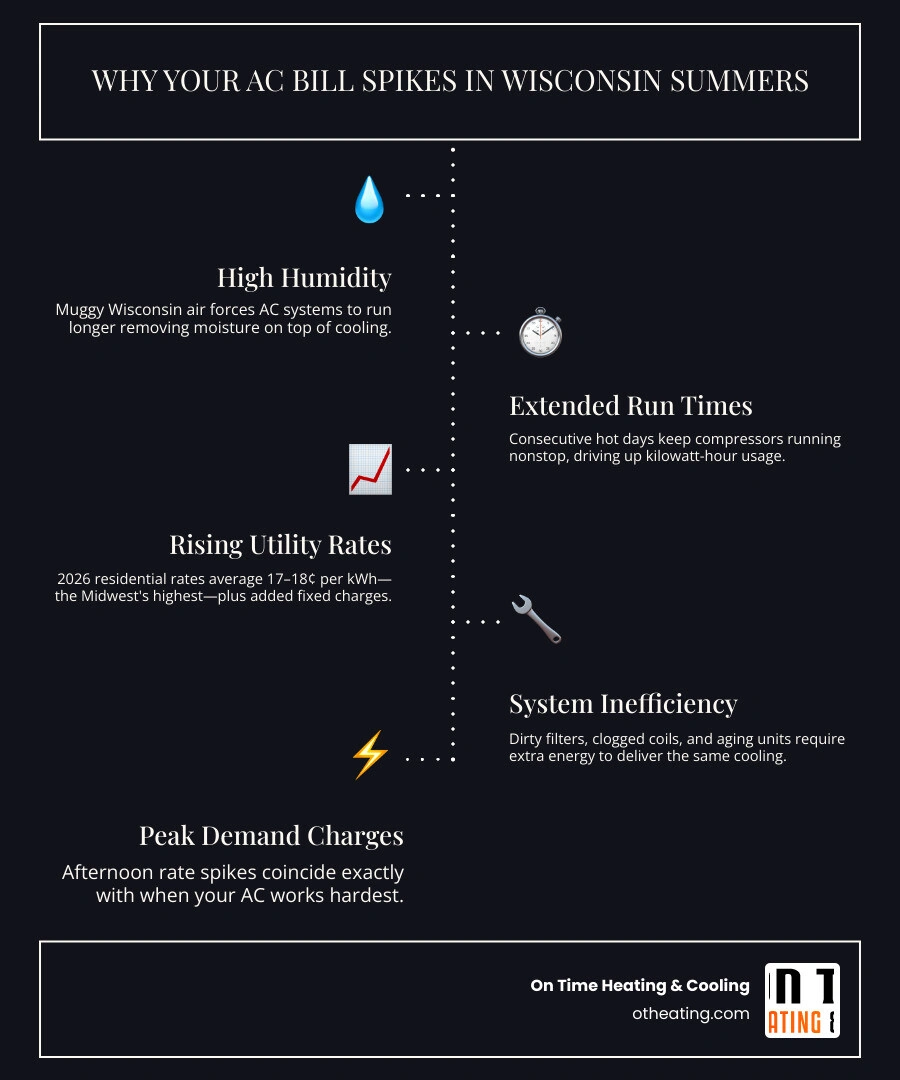
Why your AC bill spikes in Wisconsin summers comes down to a combination of factors that hit all at once: high humidity forcing your system to work harder, consecutive hot days keeping your compressor running longer, rising utility rates from Wisconsin's major providers, and the natural inefficiencies that build up in any system over time.
Here is a quick breakdown of the main reasons:
- High humidity — Wisconsin summers are muggy. Your AC doesn't just cool air, it removes moisture. The more humid it is, the harder and longer your system runs.
- Longer run times — When temperatures stay high day after day, your AC never gets a real break. More runtime means more kilowatt-hours on your bill.
- Rising electricity rates — Wisconsin residential rates average 17–18 cents per kWh in 2026, the highest in the Midwest. Approved rate hikes from major utilities like We Energies, Alliant Energy, and Xcel Energy are adding real dollars to every monthly bill.
- System inefficiencies — A dirty filter, clogged coil, or aging unit uses significantly more energy to deliver the same cooling.
- Peak demand charges — Some rate plans charge more during high-demand afternoon hours, which is exactly when your AC is working hardest.
- High fixed charges — Wisconsin utilities typically charge $15–22 per month just to be connected, regardless of how much you use.
About 92% of Wisconsin households have air conditioning, and heating and cooling together account for more than half of the average home's monthly utility costs. In a state with both harsh winters and humid summers, that pressure on your energy bill is felt year-round — but summer is when it really shows up.
The good news is that many of the causes are within your control. This guide walks you through why your bill climbs each summer and what you can actually do to bring it back down.
Many homeowners look at their electric bills in July and August and wonder how their usage could have jumped so drastically from May. While we expect some increase when we switch from heating to cooling, the extreme jump in summer utility costs in Southeast Wisconsin is often a shock. Understanding the mechanical and environmental factors at play is the first step toward learning How to Lower AC Bills During Summer.
When the outdoor temperature rises, your air conditioner works on a simple principle: it extracts heat from inside your home and transfers it outdoors. However, this process becomes significantly more complex and energy-intensive when the weather turns truly hot and sticky.
The Science Behind Why Your AC Bill Spikes in Wisconsin Summers
To understand why your cooling costs climb, we have to look at the difference between sensible heat (the temperature you read on a thermometer) and latent heat (the moisture in the air). Wisconsin's proximity to major water sources means our summers are defined by high relative humidity.
Your air conditioner is designed to handle both types of heat. As warm, humid air is pulled across the cold evaporator coil inside your home, moisture condenses on the coil and drains away. This process lowers the relative humidity, making the indoor air feel much more comfortable.
However, removing latent heat requires an immense amount of energy. When the relative humidity is high, your compressor has to work much harder and run much longer to achieve the same indoor comfort level. On a day with a high heat index, your air conditioner is essentially pulling double duty: cooling the air and squeezing out gallons of water. This heavy compressor workload is a primary reason why your ac bill spikes in wisconsin summers.
How System Inefficiencies Explain Why Your AC Bill Spikes in Wisconsin Summers
If your air conditioning system is not running at peak efficiency, the environmental challenges of a Wisconsin summer are amplified. Even minor mechanical issues can cause your system's energy consumption to skyrocket.
- Clogged Air Filters: A dirty filter restricts airflow, forcing the blower motor to work harder and run longer to circulate cool air. This restricted airflow can also cause the evaporator coil to drop below freezing, leading to ice buildup and a complete system shutdown.
- Dirty Condenser Coils: The outdoor unit (the condenser) is responsible for releasing the heat collected from inside your home. If the coils are covered in dirt, grass clippings, or cottonwood seeds, the heat transfer process is severely hindered, forcing the compressor to draw more power.
- Refrigerant Issues: If your system has a slow refrigerant leak, it won't cool effectively. The system will run continuously, trying in vain to reach your thermostat's setpoint.
Recognizing the Signs It's Time for AC Maintenance can help you address these minor inefficiencies before they manifest as massive utility bill surprises.
Wisconsin Utility Rate Structures and Summer Bill Spikes
While weather is a major driver of energy use, the structure of your electric bill plays an equally significant role. Wisconsin has some of the highest electricity rates in the Midwest, and those rates have been steadily climbing.
Rising Electricity Rates in Southeast Wisconsin
As of early 2026, Wisconsin residential electricity rates average 17–18 cents per kilowatt-hour (kWh). This places our state at the top of the Midwest for electricity costs, slightly above the national average. These high rates mean that any increase in your physical energy usage during the summer has a disproportionately large impact on your wallet.
These high rates are driven by several structural factors approved by the Public Service Commission (PSC):
- The Coal-to-Gas Transition: Wisconsin utilities are investing over $1.6 billion in natural gas infrastructure projects. This includes a $1.2 billion coal-to-gas conversion at the Oak Creek power plant. While cleaner, these massive capital projects are rolled directly into the rate base that customers pay for.
- Stranded Assets: Wisconsin ratepayers are still paying approximately $1 billion for power plants that have already been shut down. For example, customers will continue to pay for the retired Pleasant Prairie power plant through 2039.
- Data Center Demand: The rapid expansion of massive data centers, such as the Microsoft development in Mount Pleasant, requires immense amounts of electricity. While these facilities bring investment, their massive grid requirements necessitate transmission upgrades that can shift costs onto residential ratepayers.
- Guaranteed Utility Profits: Regulated utilities in Wisconsin are granted a guaranteed return on equity (often around 9.8%) for capital investments, which incentivizes large-scale building projects that increase rates.
Because of these factors, major utilities in our service areas have implemented significant rate hikes for 2026:
- We Energies customers are experiencing a cumulative 12.38% rate increase across 2025 and 2026, which adds roughly $9.73 per month to the average residential bill in 2026 alone. This follows an average monthly bill that has more than doubled over the last twenty years (from $56.18 in 2004 to $128.65 in 2024).
- Alliant Energy customers are seeing increases of about $9.57 more per month in 2026, on track to reach $17.45 more by 2027.
- Xcel Energy customers in our northern reaches face an additional $13.47 per month in 2026, climbing to $24.91 more by 2027.
Compounding this is the fact that Wisconsin has some of the highest fixed monthly charges in the country, typically ranging from $15 to $22 per month. Because you must pay this connection fee regardless of how much power you use, it blunts the financial benefit of household energy conservation and solar power.
Time-of-Use Plans and Peak Demand Charges
Many Wisconsin utilities offer Time-of-Use (TOU) rate plans. Under these plans, the price you pay for electricity fluctuates based on the time of day.
During "peak hours" (typically weekday afternoons from 2:00 p.m. to 7:00 p.m. or 9:00 p.m. when demand across the grid is highest), electricity rates can be three to five times higher than during "off-peak" overnight hours. Because your air conditioner naturally wants to run during the hottest part of the afternoon, running a standard cooling schedule on a TOU plan without shifting your load can lead to astronomical summer bills.
Modern smart meters allow utilities to track this hourly usage. If you are on a TOU plan, shifting high-energy tasks—like running the dishwasher, doing laundry, or pre-cooling your home—to off-peak hours is critical to keeping your bill manageable.
Practical Strategies to Lower Your Summer Cooling Costs
While you cannot control utility rate increases or the outdoor humidity, you have complete control over how your home uses energy. By combining smart daily habits with professional system optimization, you can mitigate the impact of summer rate hikes.
Optimizing Your Thermostat and Daily Habits
Making small adjustments to your daily routine can yield substantial savings on your monthly electric bill.
- Adopt the 78-Degree Rule: The U.S. Department of Energy recommends setting your thermostat to 78°F when you are home and awake. Every degree you raise your thermostat in the summer can cut your cooling costs by 6% to 8%. If you are away from home for more than four hours, consider raising the temperature to 85°F to prevent your system from cooling an empty house.
- Utilize Smart Thermostats: A smart thermostat automates these temperature setbacks, learning your schedule and adjusting the temperature when you leave for work. This prevents the wasteful practice of cooling an empty home while ensuring the house is comfortable by the time you return.
- Block Solar Heat Gain: Direct sunlight streaming through windows acts as a natural heater. Keep your blinds, curtains, or thermal drapes closed on the south- and west-facing sides of your home during the day to block this heat before it enters your living spaces.
- Leverage Ceiling Fans: Ceiling fans create a wind-chill effect on your skin, making a room feel 4 to 6 degrees cooler than the actual air temperature. This allows you to set your thermostat higher without sacrificing comfort. Just remember: fans cool people, not rooms, so turn them off when you leave the room. Ensure your fans are spinning counterclockwise in the summer to push a cool breeze downward.
- Shift Appliance Usage: Avoid using heat-generating appliances, like your oven or clothes dryer, during the hottest parts of the day. Opt for outdoor grilling or run your dishwasher and washing machine after sundown to keep your home's internal heat load low.
Professional Maintenance and System Upgrades
While behavioral changes are highly effective, your air conditioner must be mechanically capable of running efficiently.
Scheduling an annual professional tune-up before the peak of summer is one of the smartest investments you can make. During a professional maintenance visit, a technician will clean the coils, check refrigerant levels, calibrate the thermostat, and inspect electrical connections. This ensures your system can transfer heat as efficiently as possible, lowering its hourly energy consumption.
If your air conditioner is more than 10 to 15 years old, it may be time to consider an upgrade. Modern cooling systems are vastly more efficient than those manufactured a decade ago. Upgrading to a high-efficiency system or a modern heat pump can dramatically lower your summer energy use.
To help offset the cost of these upgrades, Wisconsin homeowners can utilize Focus on Energy, a statewide program that offers rebates for energy-efficient HVAC equipment, smart thermostats, and home insulation projects. Additionally, federal programs like the Inflation Reduction Act (IRA) provide robust tax credits and rebates for qualifying heat pumps and weatherization upgrades.
Understanding Why Regular AC Service is Essential for Home and how Routine AC Maintenance Can Extend Unit life can save you from premature system replacement and high monthly operating costs.
Localized AC Maintenance Solutions Across Southeast Wisconsin
Because local weather patterns and home styles vary across our communities, having a local HVAC partner who understands the specific demands of Southeast Wisconsin is invaluable. We are proud to provide punctual, old-school service tailored to our neighbors throughout Waukesha County, the Lake Country, and surrounding areas.
If you are looking to optimize your system's efficiency, we offer specialized, local maintenance services tailored to your neighborhood:
- AC Maintenance Waukesha WI
- AC Maintenance Brookfield WI
- AC Maintenance Menomonee Falls WI
- AC Maintenance New Berlin WI
- AC Maintenance Pewaukee WI
- AC Maintenance Delafield WI
- AC Maintenance Sussex WI
- AC Maintenance Mukwonago WI
- AC Maintenance Lannon WI
Whether you live in a historic home in Oconomowoc or a modern build in Germantown, our factory-trained technicians are familiar with the unique layouts, common ductwork challenges, and local utility requirements of your specific community.
Frequently Asked Questions About Wisconsin Summer Energy Bills
Why is my electric bill so much higher in July than June?
The dramatic jump between your June and July utility bills is primarily a story of volume and weather accumulation. June often features cooler nights and lower humidity, allowing your home to naturally cool down after the sun goes down.
By July, Wisconsin typically experiences consecutive hot days where the overnight temperatures remain high. This causes heat to accumulate in your home's thermal mass (walls, furniture, and framing). Because the outdoor temperature never drops significantly at night, your air conditioner has to run almost continuously to keep up. Additionally, July is historically much more humid, which dramatically increases the latent cooling load on your compressor.
Is it cheaper to leave the AC on all day or turn it off?
It is generally much more efficient to adjust your thermostat when you are away rather than turning the system completely off.
When you turn your AC completely off on a hot, humid day, the temperature and humidity inside your home will rise rapidly. Your walls, carpets, and furniture will absorb this heat and moisture. When you turn the system back on, it has to work at maximum capacity for hours to remove this accumulated thermal mass and humidity.
Instead, use a smart thermostat to raise the temperature by 7 to 10 degrees when you are away. This prevents your home from becoming a heat trap while reducing the overall workload on your system when you return.
How often should I replace my home's air filters in the summer?
During the peak cooling season, you should check your air filter once a month and replace it at least every 1 to 3 months.
If you have pets, live in a dusty area, or have family members with allergies, you may need to replace it more frequently. Keeping a fresh filter in place is one of the easiest ways to maintain proper airflow, protect your system's internal components, and ensure your AC Maintenance Keep System Running Smoothly all summer long.
Conclusion
While rising utility rates and humid Wisconsin summers are inevitable, high cooling bills do not have to be. By understanding how your system handles humidity, staying mindful of local utility rate structures, and implementing smart daily habits, you can keep your home comfortable without breaking the bank.
At On Time Heating & Cooling, we are dedicated to helping our neighbors in Menomonee Falls and throughout Southeast Wisconsin stay cool and save energy. Our commitment to punctuality, old-school customer care, and modern HVAC practices ensures your system is always running at its absolute best.
If you are ready to protect your home from summer rate hikes, Schedule professional AC service in Waukesha with our friendly, expert team today.
Related Articles
 Cooling
The Great Spring HVAC Transition: From Toasty to Tasty Cool
Master your spring hvac transition from heating to cooling with our 5-step checklist, DIY tips, and pro maintenance for peak efficiency.
Read Article Cooling
The Ultimate Guide to Choosing the Right AC for Your Wisconsin Home
Learn how to choose the right AC for your Wisconsin home with expert tips on systems, sizing, efficiency, and professional installation.
Read Article Cooling
Everything Homeowners Need to Know About the 2026 Refrigerant Transition
Learn how AC refrigerant changes affect homeowners in 2026: R-410A phase-out, new A2L options, repairs, efficiency & incentives.
Read ArticleNeed HVAC help?
Whether you need a repair, maintenance, or a new installation, our expert team is here to help.