When to Call a Professional for AC Problems
Know when to call a professional for AC problems with this Waukesha guide covering DIY checks, warning signs, and expert AC repair decisions.
Shane Herro
Owner & Lead Tech

Know when to call a professional for AC problems with this Waukesha guide covering DIY checks, warning signs, and expert AC repair decisions.
How to Know When to Call a Professional for AC Problems
Knowing when to call a professional for AC problems can be the difference between a quick fix and a full system breakdown — especially during a Wisconsin summer when your home in Menomonee Falls, Waukesha, or Brookfield is depending on reliable cooling.
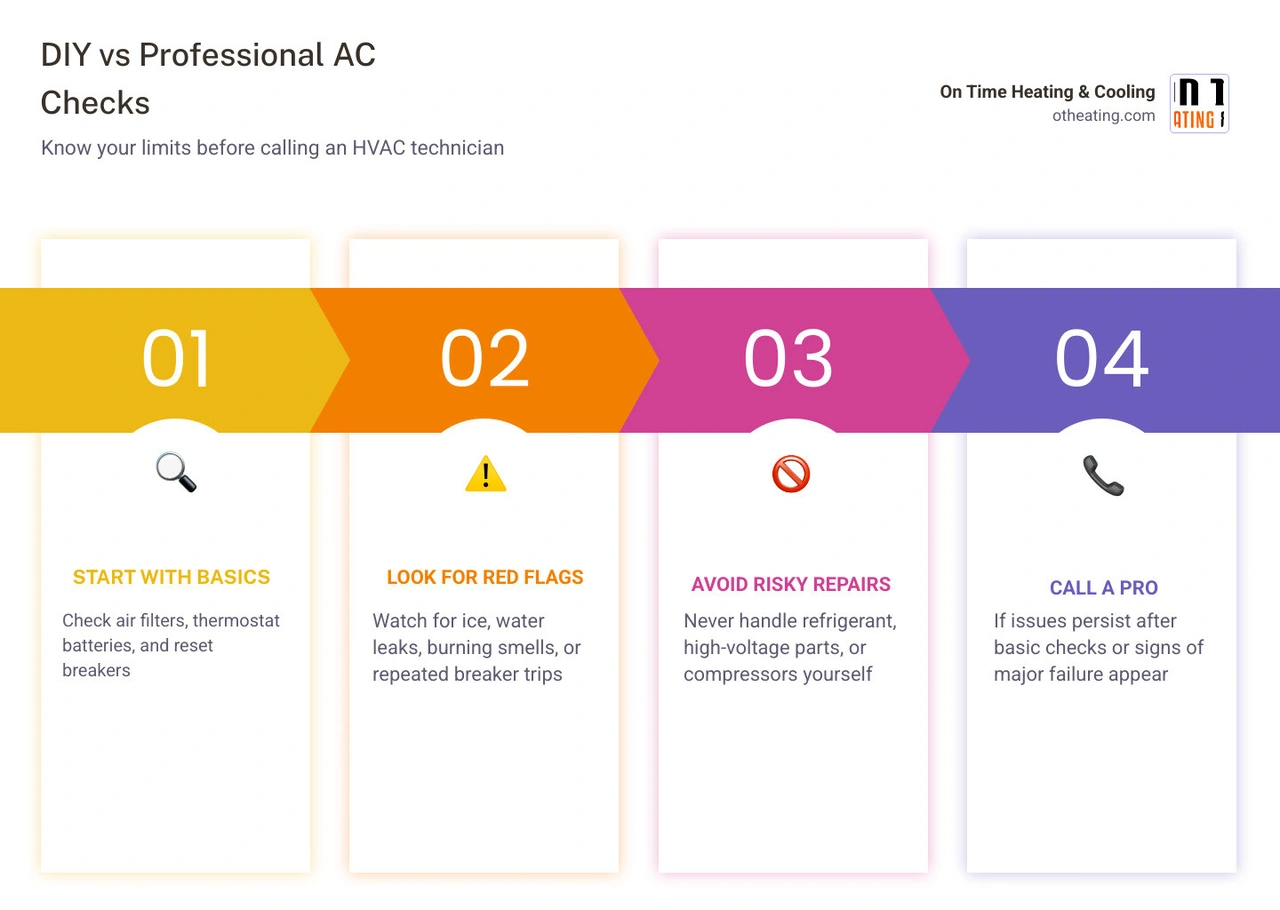
Before you pick up the phone, here are the most common situations that require a professional HVAC technician:
- Your AC is blowing warm air despite correct thermostat settings
- Ice is forming on the refrigerant lines or evaporator coils
- Water is pooling around your indoor unit
- You smell burning or notice a sweet chemical odor from vents
- Your circuit breaker keeps tripping after being reset
- Your system is making loud or unusual noises — hissing, clanging, or grinding
- Your AC is short cycling (turning on and off repeatedly)
- Your energy bills are spiking without a clear reason
- Basic troubleshooting hasn't fixed the problem after checking filters, thermostat, and breakers
For simple issues — like a dirty filter, a tripped breaker, or a thermostat with dead batteries — most homeowners can troubleshoot safely on their own. But when symptoms go beyond the basics, attempting DIY repairs on refrigerant lines, electrical components, or compressors can be dangerous and may void your manufacturer warranty.
According to industry data, annual professional maintenance can prevent up to 80% of common AC repair issues. And nearly 90% of central air service calls trace back to water leaks or condensate drain problems — many of which escalate because homeowners waited too long to call.
This guide walks you through exactly what you can handle yourself, what requires a licensed HVAC technician, and how to protect your system — and your home — before small problems become expensive ones.
When to call a professional for ac problems further reading:
DIY Troubleshooting vs. When to Call a Professional for AC Problems

When your air conditioner begins to struggle on a humid July afternoon, the temptation to grab a toolbox and start tinkering is incredibly strong. After all, the internet is packed with video tutorials claiming that anyone can fix a complex cooling system with a bit of determination. However, there is a very strict boundary between safe, routine homeowner maintenance and dangerous, highly technical diagnostics.
Understanding this boundary is essential for your safety, the longevity of your equipment, and the validity of your manufacturer's warranty. Modern cooling systems are highly sophisticated machines containing high-voltage electrical circuits, pressurized chemical refrigerants, and sensitive microprocessors. Making a single mistake can transform a minor component issue into a complete system failure.
To help you determine your next steps safely, we highly recommend reviewing our comprehensive list of AC Troubleshooting Tips Before Calling a Pro before attempting any diagnostic work.
Safe AC Maintenance Tasks for Homeowners
There are several basic tasks that you can—and should—perform regularly to keep your air conditioner running smoothly. These simple steps resolve approximately 20% to 30% of all cooling performance issues without the need to schedule a service visit:
- Air Filter Replacement: This is the single most important task a homeowner can perform. Clogged, dusty filters restrict airflow, forcing your system to work twice as hard. Check your filter every 30 days during peak cooling seasons and replace it at least once every two months (or monthly if you have shedding pets).
- Outdoor Unit Clearance: Keep the area around your outdoor condenser unit clear of grass clippings, weeds, leaves, and debris. Maintain at least two feet of clear space around the entire perimeter of the metal cabinet to ensure proper heat transfer.
- Thermostat Power and Settings: If your system won't start, check your thermostat display. If it is blank, replace the batteries. Ensure the system is set to "Cool" and the fan is set to "Auto" rather than "On" (which runs the fan continuously even when the system isn't cooling).
- Register Vent Inspection: Walk through your home to ensure that supply registers and return grilles are completely open and unobstructed by furniture, rugs, or drapes.
If you have verified all of these basic components and your home is still uncomfortably warm, it is time to dig deeper into what might be happening. You can find a complete diagnostic checklist in our guide on AC Not Cooling Properly What to Check.
When to Call a Professional for AC Problems Involving Complex Components
Once you step past air filters and thermostat batteries, you enter the territory of complex mechanical and electrical components. These parts require specialized tools, advanced diagnostic equipment, and certified expertise to handle safely.
First and foremost is refrigerant handling. Under federal law (specifically EPA Section 608 regulations), it is illegal for anyone without proper certification to handle, recharge, or dispose of chemical refrigerants. If your system is low on refrigerant, it means you have a leak. Simply adding more refrigerant without locating and sealing the leak is illegal, harmful to the environment, and destructive to your compressor.
Second is high-voltage electricity. Your air conditioner runs on heavy-duty electrical circuits. Components like the dual-run capacitor store dangerous levels of electrical energy even after you have shut off the main breaker. Attempting to replace a capacitor or handle frayed wiring without proper training carries a severe risk of electrical shock or electrical fire.
Finally, internal mechanical parts like the blower motor and the compressor require precise calibration and torque specifications. If your system is completely unresponsive, check out our guide on AC Not Turning On to understand when the issue lies deep within these complex mechanical assemblies.
Critical Warning Signs That Require Immediate Expert Attention
Some air conditioning issues are quiet, gradual declines in performance. Others are loud, immediate red flags that demand you shut down your system immediately and call in an expert. Ignoring these warning signs can ruin your system's most expensive components, such as the compressor, or even threaten your home's safety.
If you notice any of the warning signs detailed below, refer to our central guide on Signs Your AC Needs Repair to understand how these symptoms develop.
To help you quickly distinguish between a minor inconvenience and a major cooling emergency, refer to the comparison table below:
| Minor Symptom (Monitor & Schedule) | Major AC Emergency (Shut Down & Call Immediately) |
|---|---|
| Slightly uneven cooling between rooms | Burning, electrical, or sweet chemical odors |
| Air filter is grey and dusty | Thick ice building up on refrigerant lines or indoor coils |
| Thermostat batteries are low | Rapidly pooling water indoors around the air handler |
| Outdoor unit has minor dirt on cabinet | Circuit breaker trips immediately after a single reset |
| System cycles slightly longer on very hot days | Loud screeching, grinding, or metallic clanging |
Water Leaks and Frozen Evaporator Coils
Water leaks are incredibly common, accounting for nearly 90% of all central air conditioning service calls. Your AC doesn't just cool your home; it also dehumidifies it. As warm indoor air passes over the freezing evaporator coil, moisture condenses on the metal fins and drips into a drain pan, exiting your home through a condensate drain line.
If this drain line becomes clogged with algae, mold, or dust, the water has nowhere to go but backward. It will overflow the drain pan, pooling around your indoor furnace or air handler. If left unaddressed, this water can ruin drywall, warp hardwood flooring, and encourage toxic mold growth.
Another severe moisture issue is a frozen evaporator coil. When airflow is heavily restricted (due to a filthy filter) or refrigerant levels are low, the temperature of the coil drops below freezing. The condensation on the coil turns to ice, completely blocking airflow. If you see ice forming on the brass valves of your outdoor unit or find a block of ice inside your indoor cabinet, turn the system off immediately and set the thermostat fan to "On" to let it thaw. Do not attempt to scrape the ice off yourself, as this will puncture the delicate aluminum fins.
For a deeper dive into this freezing phenomenon, read our guide on AC Freezing Up.
Electrical Failures and Repeatedly Tripping Breakers
Your electrical panel is designed to protect your home from electrical fires. If your air conditioner draws more electrical current than its circuit is rated to handle, the breaker will trip, shutting off power to the unit.
If your AC trips the breaker once, it could be a fluke caused by a temporary power surge in your neighborhood. You can safely reset the breaker once. However, if the breaker trips a second time, do not attempt to reset it again.
Repeatedly resetting a tripping breaker can cause the electrical wiring to overheat, presenting a severe fire hazard. This symptom typically indicates a short circuit, a failing capacitor that cannot properly assist the motor, or a compressor that is failing mechanically and drawing excessive electrical current to start up.
To learn more about what causes this dangerous issue, consult our guide on AC Circuit Breaker Keeps Tripping What It Means.
Strange Noises and Burning Smells
Your air conditioner should operate with a gentle, predictable hum. If you begin hearing unusual sounds, your system is telling you that something is mechanically or electrically wrong:
- Hissing: This is a classic sign of a high-pressure refrigerant leak. It can also indicate leaky, disconnected ductwork.
- Clanging or Rattling: This usually means a fan blade has bent, a motor mount has broken, or a loose component is bouncing around inside the blower cabinet.
- Screeching or Grinding: This points directly to failing bearings inside the condenser fan motor or the blower motor.
Even more urgent than strange noises are unusual odors. If you detect a distinct burning smell or notice smoke coming from your vents or outdoor unit, shut down the system at the thermostat, turn off the main breaker, and call for emergency service. This is a clear sign of overheated wiring, a burned-out motor, or a failing compressor.
You can find a detailed breakdown of these auditory warning signs in our article on AC Making Strange Noises What They Mean.
The Risks of Delaying Professional AC Repairs
When an air conditioner is struggling but still managing to keep the house somewhat cool, many homeowners decide to delay calling for service. They assume that as long as the system is running, they can put off the repair. This is a costly mistake.
In HVAC, minor issues do not resolve themselves; they cascade. A small, inexpensive problem left unaddressed will inevitably put extra strain on other components, leading to a much larger, more expensive breakdown.
If your system is showing signs of distress during a severe heatwave, read When an HVAC Failure Is a True Emergency to understand why immediate action is required.
System Efficiency and Skyrocketing Energy Bills
When your AC has a minor mechanical issue—such as a dirty condenser coil, a failing capacitor, or restricted airflow—it loses its ability to transfer heat efficiently. To compensate for this loss of cooling capacity, the system must run for much longer cycles to reach the temperature set on your thermostat.
This extra runtime directly translates to skyrocketing energy bills. You are essentially paying more money for less comfort. Additionally, if your home has leaky air ducts, you could be losing 20% to 30% of your conditioned air into your attic, basement, or wall cavities before it ever reaches your living spaces.
By delaying a professional inspection, you are wasting money on utility bills that could have easily gone toward a quick, professional tune-up.
Compressor Damage and Voided Manufacturer Warranties
The compressor is the heart of your air conditioning system. It is the pump that circulates refrigerant between the indoor and outdoor coils. It is also the most expensive component in the entire system to replace.
When you run an air conditioner that has a refrigerant leak, the compressor is deprived of the cooling oil that circulates alongside the refrigerant. This causes the compressor to overheat, undergo severe friction, and eventually burn out. A simple refrigerant leak that could have been resolved with a quick repair can easily turn into a catastrophic compressor failure.
Furthermore, attempting DIY repairs on internal components or delaying professional service can void your manufacturer's warranty. Most major HVAC manufacturers explicitly state in their warranty terms that all diagnostics, repairs, and annual maintenance must be performed by a licensed, certified HVAC technician. If you attempt to fix a component yourself and cause further damage, the manufacturer will likely deny any warranty claims, leaving you fully responsible for the cost of replacement parts.
If you suspect your system has a leak, read our detailed guide on AC Refrigerant Leak Detection to see how professionals locate and resolve these issues.
Repair vs. Replacement: Making the Right Choice for Your Home
Eventually, every homeowner faces a difficult decision: Should you continue to invest money into repairing your current air conditioner, or is it time to replace it with a new, energy-efficient system?
This decision doesn't have to be a guessing game. By applying a few industry-standard financial and physical rules, you can make an informed, cost-effective choice for your home in Southeast Wisconsin.
Evaluating System Age and the 15-Year Rule
With proper professional maintenance, a high-quality central air conditioning system typically lasts between 15 and 25 years. However, once a unit crosses the 10-to-15-year mark, its mechanical components naturally begin to wear down, and its overall efficiency drops.
If your system is more than 10 years old and requires frequent, repetitive repairs, it is likely nearing the end of its reliable lifespan. Another major consideration is the type of refrigerant your system uses. If your AC was installed before 2010, it likely runs on R-22 (Freon). The EPA has completely phased out the production and import of R-22, making any repairs that require recharging the system extremely costly and difficult to source.
To evaluate the financial side of the decision, we recommend using the 50% Rule: if the cost of a single repair exceeds 50% of the total value of a brand-new system, replacement is almost always the smarter long-term investment. You can also apply the $5,000 Rule (conceptually multiplying the age of your system by the repair estimate; if the result is over 5,000, replacement is highly recommended).
When to Call a Professional for AC Problems to Discuss Replacement Options
If you decide that replacement is the right path forward, a professional technician can help you design a perfectly matched system for your home. Modern air conditioners are significantly more efficient than those built even a decade ago, utilizing advanced SEER2 ratings and variable-speed technology.
Unlike old-school systems that run at either 0% or 100% capacity, variable-speed compressors adjust their speed in tiny increments to match the exact cooling needs of your home. This eliminates temperature swings, removes far more humidity from the air, and cuts your cooling energy consumption by up to 20% to 40%.
Additionally, installing a new, high-efficiency system can significantly boost your home's resale value and make you eligible for valuable federal tax credits and local utility rebates.
For a complete guide on how to handle a sudden system failure during peak summer heat, refer to our Emergency AC Repair Waukesha Guide.
Frequently Asked Questions About AC Repairs
How often should I schedule professional AC maintenance?
You should schedule professional AC maintenance at least once a year, ideally in the early spring before the heavy cooling season begins. Regular maintenance is preventative care; it allows a technician to clean the condenser coils, check refrigerant levels, test capacitors, and catch tiny component failures before they escalate into major mid-summer breakdowns. For older systems (10+ years old), bi-annual inspections are highly recommended.
Is a hissing noise from my AC an emergency?
Yes, a hissing noise should be treated as an emergency. A distinct hissing sound typically indicates a high-pressure refrigerant leak or a malfunctioning internal valve within the compressor. Because running an air conditioner with low refrigerant can quickly destroy the compressor, you should shut down the system immediately and call a licensed professional to perform a leak detection test.
Why is my air conditioner blowing warm air despite the settings?
If your system is blowing warm air, start by verifying that your thermostat is set to "Cool" and the fan is set to "Auto" rather than "On." If the settings are correct, the issue is likely a clogged air filter, dirty evaporator coils, a tripped outdoor circuit breaker, or a refrigerant leak. Turn the system off to prevent compressor damage and contact a professional technician to diagnose the root cause.
Conclusion
Understanding when to call a professional for AC problems is the best way to protect your home's comfort, your family's safety, and your financial investment. While basic tasks like changing air filters and clearing yard debris are excellent DIY habits, complex electrical and refrigerant issues should always be left to certified experts.
At On Time Heating & Cooling, we are dedicated to keeping homes in Menomonee Falls, Waukesha, Brookfield, and the surrounding Southeast Wisconsin communities perfectly comfortable all year long. Our factory-trained, highly skilled technicians are committed to absolute punctuality, blending old-school customer service with modern HVAC practices.
To enjoy year-round peace of mind, priority service, and exclusive discounts on repairs, we invite you to join our On The Dot Club maintenance program. Don't spend another day struggling with an unreliable air conditioner. Schedule professional HVAC services today and let our friendly team ensure your home's climate control is done right!
Related Articles
 Maintenance
Melting the Mystery of Frozen AC Units
Fix ice forming on your ac unit causes and what to do. Learn how to defrost your system and prevent costly damage today.
Read Article Maintenance
How to Stop AC Running Constantly in Wisconsin Heat Waves
Discover why your AC runs constantly during Wisconsin heat waves and learn proven fixes to restore comfort and cut energy costs.
Read Article Maintenance
5 Common AC Repairs and What Causes Them
Discover the most common AC repairs and what causes them in Brookfield WI homes, plus DIY checks and repair-or-replace tips from local pros.
Read ArticleNeed HVAC help?
Whether you need a repair, maintenance, or a new installation, our expert team is here to help.