How Contaminated Ducts Increase Your Energy Bills and Waste Money
Discover how contaminated ducts increase your energy bills and learn practical steps to restore HVAC efficiency and cut waste.
Shane Herro
Owner & Lead Tech

Discover how contaminated ducts increase your energy bills and learn practical steps to restore HVAC efficiency and cut waste.
Why Your Energy Bills Keep Climbing — and What Your Ducts Have to Do With It
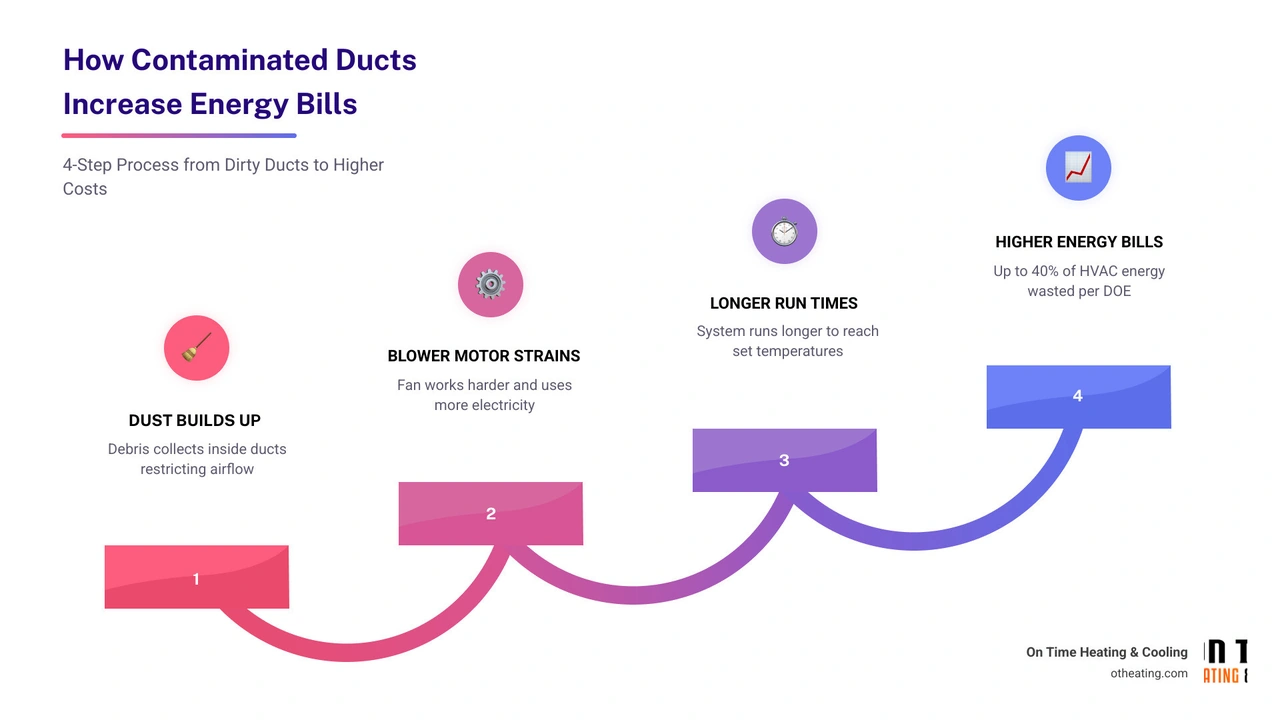
Understanding how contaminated ducts increase your energy bills is the first step toward stopping the waste. When dust, debris, and buildup collect inside your ductwork, your HVAC system has to work harder to push air through — and that extra effort shows up directly on your utility bill.
Here is a quick breakdown of how it happens:
- Restricted airflow forces your blower motor to run longer and consume more electricity
- Dust on coils acts as insulation, reducing heat transfer and making your system less effective
- Longer run times mean more energy used to reach the same indoor temperature
- Duct leaks allow conditioned air to escape into attics or crawl spaces before it ever reaches your living areas
- Uneven heating and cooling causes your thermostat to overcompensate, adding even more runtime
According to the U.S. Department of Energy, somewhere between 25% and 40% of the energy used to heat or cool a home is wasted — and contaminated or inefficient ductwork is one of the biggest contributors to that loss. For homeowners in Menomonee Falls and across Southeast Wisconsin, where heating and cooling systems work hard through both cold winters and humid summers, that wasted energy adds up fast.
If your energy bills have been creeping up month after month without a clear reason, your ductwork may be the culprit hiding in plain sight.
The Science of Airflow: How Contaminated Ducts Increase Your Energy Bills
To understand why dirty ducts cost so much, we have to look at the physics of how your home breathes. Your heating and cooling system relies on a delicate balance of pressure and airflow. Think of your HVAC system as the lungs of your home. It pulls air in, conditions it (heats or cools it), and breathes it back out through a network of sheet metal, fiberglass, or flexible tubing.
When everything is clean, air flows smoothly with minimal resistance. However, over the years, everyday life happens. Dust, pet hair, dander, pollen, and even construction debris from past remodeling projects settle inside those pathways. This buildup changes the interior texture of your ducts from smooth metal to a rough, friction-heavy surface.
This friction creates what HVAC professionals call static pressure issues. In simple terms, static pressure is the resistance your system's blower motor has to overcome to circulate air. When static pressure is too high because of debris blockages, the system struggles to move air. To dive deeper into how this structural strain affects your system, check out our guide on How Dirty Air Ducts Impact HVAC Performance.
Airflow Resistance and Blower Motor Strain
When your ductwork is restricted, your blower motor has to work significantly harder to distribute air to your living spaces. Imagine trying to breathe through a drinking straw that is partially clogged with sand. You would have to exert far more effort just to get a single breath of air.
Your blower motor reacts the same way. When faced with restricted airflow, it draws more electrical current to maintain its target output. This added friction means the motor runs hotter and draws extra wattage. Instead of operating at its designed efficiency, a blower motor fighting dirty ducts may require 5% to 15% more electricity just to move the same volume of air.
Over time, this constant electrical strain does more than just drive up your monthly utility costs. It accelerates wear and tear on the motor itself, leading to premature component failure. You can learn more about this cycle of strain by reading about How Dirty Ducts Affect Your HVAC Performance.
The Insulating Effect of Dust on Coils
The financial impact of dirty ducts does not stop at the blower motor. Your HVAC system relies on heat transfer to keep you comfortable. In the summer, the evaporator coil inside your air handler absorbs heat from your indoor air. In the winter, your furnace's heat exchanger transfers heat to the circulating air.
As dirty air continuously recirculates through contaminated ducts, fine dust particles bypass your air filter and settle directly onto these critical heat transfer surfaces. Dust is actually an excellent natural insulator. When a layer of dust — even one as thin as a fraction of an inch — coats your evaporator coil, it creates a thermal barrier.
According to research from the EPA and the National Air Duct Cleaners Association (NADCA), removing as little as 0.042 inches of dirt buildup from heating and cooling coils can restore heat transfer efficiency and reduce energy consumption by up to 21%. When coils are insulated by dirt, your system has to run much longer to cool or heat the air, driving up your power bills. To see how professional cleaning solves this issue, read about How Air Duct Cleaning Improves Your HVAC.
The Financial Impact of Clogged Ductwork on Homeowners
The real-world financial consequences of ignoring your ductwork are substantial. Heating and cooling make up nearly half of the average home's energy consumption. When a system is wasting 25% to 40% of its energy due to system inefficiencies and dirty ducts, the dollar amount wasted over a single season is eye-opening.
Let us look at a side-by-side comparison of how a clean duct system performs versus one that has been neglected for years:
| Metric | Clean Duct System | Contaminated Duct System |
|---|---|---|
| Airflow Efficiency | Unrestricted, optimal velocity | Highly restricted, high static pressure |
| Blower Motor Electrical Draw | Standard (per manufacturer spec) | Elevated by 5% to 15% |
| Average HVAC Energy Waste | Minimal (0% to 5%) | 25% to 40% wasted energy |
| System Lifespan Expectancy | Full expected lifespan (15–20 years) | Reduced by 3 to 5 years due to strain |
| Consistency of Temperatures | Even heating and cooling | Hot and cold spots throughout the home |
| Average Monthly Bill Impact | Baseline utility costs | 10% to 30% higher utility costs |
For a household spending a couple of thousand dollars a year on heating and cooling, a 20% to 30% reduction in efficiency means hundreds of dollars are literally flying out of your pockets and into the atmosphere. Over the 15-year lifespan of a typical furnace or air conditioner, maintaining clean ducts can save thousands of dollars in cumulative energy and repair costs.
How Contaminated Ducts Increase Your Energy Bills Through Longer Run Times
Because dirty ducts restrict airflow and insulate heat exchange surfaces, your HVAC system has to run for much longer periods to satisfy your thermostat settings. Instead of a standard, efficient 15-minute cycle, your system might run for 25 or 30 minutes at a time.
These extended cycles mean your home's mechanical components are operating for hours longer every single day. When cycles are prolonged, your home experiences uneven heating and cooling. You might notice that while the room with the thermostat feels comfortable, your bedroom or home office remains stubborn and drafty.
This temperature imbalance often leads homeowners to make frequent thermostat adjustments. Out of frustration, you might bump the thermostat up a few degrees in the winter or slide it down in the summer to make those uncomfortable rooms tolerable. This overcompensation forces your system to run even longer, compounding the energy waste.
Conditioned Air Loss and Duct Leaks
Contaminated ducts and leaky ducts often go hand in hand. As dust and debris accumulate, they can weigh down flexible ductwork, causing it to sag, kink, or pull away from connection joints. In rigid sheet metal systems, the increased static pressure from severe blockages can actually force air out of loose seams and joints.
ENERGY STAR estimates that in a typical home, about 20% to 30% of the air that moves through the duct system is lost due to leaks, holes, and poorly connected ducts. When these leaks occur in unconditioned spaces like your attic, crawl space, or unfinished basement, you are paying to heat and cool spaces where nobody lives.
To put this in perspective, a one-inch hole in an attic duct ductwork system loses as much energy as leaving a 10-inch by 10-inch window wide open all year round. Your HVAC system has to work double-time to make up for this lost air, pulling more energy from the grid. To understand the relationship between duct integrity and overall system health, check out our HVAC Maintenance Ultimate Guide.
Signs Your Ductwork is Driving Up Your Utility Costs
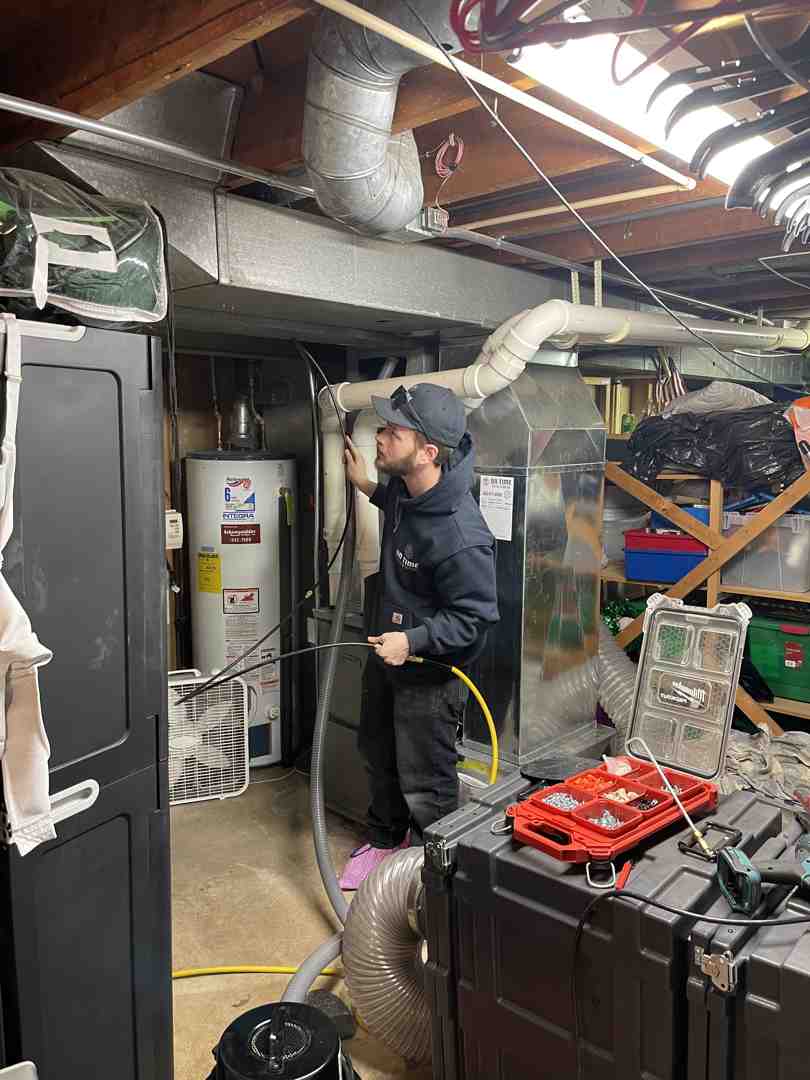
How do you know if your ductwork is secretly draining your bank account? Because ducts are hidden behind walls, under floors, and in ceilings, it is easy to adopt an "out of sight, out of mind" attitude. However, your home will drop several clues when its air delivery system is struggling.
Keep an eye out for these common warning signs:
- Unexplained spikes in utility bills: If your energy bills are noticeably higher than they were during the same month last year, but your household habits haven’t changed, your HVAC system is likely losing efficiency.
- Weak airflow from registers: Walk around your home and place your hand over the supply vents. If the air feels like a gentle whisper rather than a steady, strong breeze, there is a blockage or leak somewhere in the line.
- Rapid dust accumulation: If you find yourself dusting your furniture only to see a fine gray film return within 24 hours, your ducts are likely loaded with debris that recirculates every time the blower turns on.
- Musty or stale odors: When the furnace or air conditioner kicks on, do you notice a stale, dusty, or "dirty sock" smell? Damp dust inside your ductwork can harbor microbial growth, adding physical resistance to the air and polluting your indoor environment.
- Rooms that won't stay comfortable: If your living room is a freezer while your kitchen is a sauna, your ductwork is failing to distribute air evenly, forcing the system to run longer to compensate.
Identifying How Contaminated Ducts Increase Your Energy Bills in Southeast Wisconsin
For those of us living in Southeast Wisconsin — whether you are in Menomonee Falls, Waukesha, Brookfield, Sussex, or Pewaukee — our local climate puts our HVAC systems through a true endurance test. We experience humid summers that require heavy air conditioning, followed by freezing winters where our furnaces run almost continuously.
Because our systems run so frequently, dust and airborne particles are constantly pulled through our ducts. If you live in an area with high seasonal pollen or have a busy household with kids and pets in New Berlin or Oconomowoc, that buildup accumulates even faster.
When your system is forced to run extended cycles during a Wisconsin cold snap or a humid July heatwave, even a minor drop in duct efficiency translates to a massive jump in your monthly utility bills. Keeping your ductwork clean ensures that every dollar you spend on your energy bill actually goes toward keeping your family comfortable.
Restoring Efficiency: Professional Cleaning vs. DIY Maintenance
When homeowners realize how contaminated ducts increase your energy bills, the immediate reaction is often to look for a quick fix. While there are several excellent DIY maintenance steps you can take to keep your system clean, there is a major difference between basic surface maintenance and deep professional cleaning.
For DIY care, we always recommend that homeowners stay on top of regular filter changes. Checking your air filter every month and replacing it when it looks gray or dusty is the single best way to prevent new debris from entering your system. You can also use your household vacuum to clean off your supply and return vent grilles to keep them free of surface dust.
However, these steps only address the entry and exit points of your system. They cannot reach the hundreds of feet of ductwork winding through your walls and ceilings. To explore the full range of benefits that come with deep cleaning, read about the Benefits of Professional Air Duct Cleaning.
Why Professional Cleaning Outperforms DIY Methods
True duct cleaning requires specialized, commercial-grade equipment to safely pull years of stubborn, impacted debris out of your home. If you attempt to clean deep inside your ducts with a standard shop vac or a flexible brush attachment, you risk doing more harm than good.
Without the proper negative pressure equipment, DIY cleaning attempts often just loosen dust and release it into your living spaces, worsening your indoor air quality and making your home dustier than before. Furthermore, improper DIY scraping can easily tear flexible ductwork or damage internal fiberglass linings, creating costly leaks.
Professional HVAC technicians use high-powered vacuum systems equipped with HEPA filtration. These vacuums connect directly to your main trunk line, placing the entire duct system under negative pressure. As specialized rotary brushes and air whips loosen the debris inside the branches, the vacuum pulls every particle out of your home and into a sealed containment unit. To learn more about what a thorough, professional service looks like, refer to our Air Duct Cleaning Complete Guide.
Recommended Maintenance Schedule for Optimal Efficiency
To maintain peak energy efficiency and keep your utility bills low, how often should you have your ducts cleaned? For the average home in Southeast Wisconsin, having your air ducts professionally inspected and cleaned every 3 to 5 years is a highly effective standard.
However, certain household factors can cause debris to build up much faster, requiring more frequent attention:
- Pets in the home: Pet hair and dander are highly sticky and quickly cling to duct walls, creating a trap for other dust particles. If you have multiple furry family members, consider cleaning every 2 to 3 years.
- Recent home renovations: Drywall dust, sawdust, and flooring debris are incredibly fine and easily bypass standard filters during a remodel, settling deep inside your return ducts.
- Allergies or respiratory sensitivities: If anyone in your family suffers from asthma or seasonal allergies, keeping the ductwork clean prevents the continuous recirculation of triggers.
- High indoor humidity: In humid areas or homes with damp basements, dust inside ducts can absorb moisture, leading to mold or fungal growth that restricts airflow.
To understand the long-term value of keeping your system on a consistent schedule, check out our article on the Importance of Regular Air Duct Cleaning.
Frequently Asked Questions About Duct Cleaning and Energy Savings
How much energy can I save by cleaning my air ducts?
While exact savings depend on how dirty your ducts are, the age of your equipment, and your local climate, homeowners who invest in professional duct cleaning and comprehensive HVAC maintenance routinely report energy bill reductions of 10% to 30%.
By removing airflow restrictions and cleaning insulated coils, your system can run shorter, more efficient cycles, which directly lowers your electricity and heating fuel consumption. To see how these efficiency gains translate to better system performance, read about How Clean Air Ducts Improve Your HVAC System.
How do I know if my air ducts need to be cleaned?
The easiest way to tell is to perform a quick visual inspection. Remove a vent cover on one of your return registers and look inside with a flashlight. If you see a thick layer of dust, matted pet hair, or dark cobwebs clinging to the sides, your entire system is likely due for a professional cleaning. Other clear indicators include uneven room temperatures, weak airflow, and a sudden, unexplained rise in your monthly utility costs.
How can I avoid air duct cleaning scams?
Unfortunately, the duct cleaning industry has its share of "blow-and-go" operations. These are companies that advertise unbelievably low rates to get their foot in the door, only to perform a superficial vacuuming job and hit you with aggressive upsells for mold remediation or extra fees.
To protect yourself, always look for reputable, locally established HVAC contractors. Ensure they are certified by the National Air Duct Cleaners Association (NADCA), which guarantees they follow strict industry standards. A trustworthy company will gladly provide a transparent breakdown of their process, use high-powered negative pressure equipment, and offer honest, upfront communication.
Conclusion
At On Time Heating & Cooling, we understand that a comfortable home shouldn't have to come with sky-high utility bills. Since our founding, we have served homeowners across Menomonee Falls and Southeast Wisconsin — including Waukesha, Brookfield, Sussex, Hartland, Delafield, and beyond — with a simple promise: to combine old-school customer service with modern, energy-saving practices.
Our team of factory-trained, punctual technicians is dedicated to helping you restore your HVAC system's peak efficiency. Whether you need a comprehensive duct inspection, a seasonal tune-up, or want to enjoy the priority service and regular maintenance benefits of our "On The Dot Club," we are here to ensure your system runs exactly as it should.
Don't let dirty ductwork quietly drain your budget. Schedule professional duct cleaning with On Time Heating & Cooling today, and let us help you bring your energy bills back down to earth!
Related Articles
 general
Furnace Options Comparisons For Homeowners: What On Time Heating & Cooling Reviews Reveal
Read Article general
Why Does My Furnace Smell Like Burning Dust? A Waukesha Homeowner's Guide to Fall Startup
Read Article general
What On Time Heating & Cooling Reviews Reveal About Our Waukesha Fall Furnace Startups
Read ArticleNeed HVAC help?
Whether you need a repair, maintenance, or a new installation, our expert team is here to help.