R410A vs R454B Refrigerant: Terms Demystified
Learn r410a vs r454b refrigerant what you need to know about the EPA-mandated switch and how it affects your Wisconsin AC system.
Shane Herro
Owner & Lead Tech

Learn r410a vs r454b refrigerant what you need to know about the EPA-mandated switch and how it affects your Wisconsin AC system.
What Homeowners Need to Know About R410A vs R454B Refrigerant Right Now
If you're trying to understand r410a vs r454b refrigerant what you need to know before buying a new system or servicing an existing one, here's the short version:
| Feature | R-410A | R-454B |
|---|---|---|
| Global Warming Potential (GWP) | 2,088 | 466 (78% lower) |
| Flammability Class | A1 (non-flammable) | A2L (mildly flammable) |
| New Equipment Allowed? | No — banned after Jan 1, 2025 | Yes — current standard |
| Drop-In Replacement? | N/A | No — requires new equipment |
| Energy Efficiency | Baseline | 3–5% higher COP |
| Service for Existing Systems? | Yes — reclaimed refrigerant available | N/A |
The HVAC industry is in the middle of one of its biggest shifts in decades. R-410A, the refrigerant that has cooled most American homes for over 20 years, is being phased out under the EPA's AIM Act. As of January 1, 2025, manufacturers can no longer produce or import new residential HVAC systems that use R-410A. Its replacement — R-454B, sold commercially as Opteon XL41 — carries a dramatically lower environmental footprint while delivering comparable or slightly better performance.
For homeowners in Menomonee Falls and across Southeast Wisconsin, this transition raises real questions. Can you still service your existing system? Is the new refrigerant safe? Do you need to replace your equipment right now? This guide breaks it all down in plain language.
Why the HVAC Industry is Transitioning to R-454B
To understand why we are making this change, we have to look at how chemical standards have evolved. For years, R-410A was the eco-friendly hero because it replaced R-22 (Freon), a refrigerant that was actively depleting the Earth's protective ozone layer. While R-410A successfully solved the ozone depletion problem, scientists and regulators later realized that it possessed an incredibly high Global Warming Potential (GWP).
As we navigate this industry-wide update in June 2026, the transition to R-454B represents the next logical step in balancing home comfort with environmental responsibility. Understanding How AC Refrigerant Changes Affect Homeowners is the first step in future-proofing your home's cooling system.
Environmental Impact and GWP Values
The primary metric driving this transition is Global Warming Potential (GWP). GWP measures how much energy the emissions of 1 ton of a gas will absorb over a given period, relative to 1 ton of carbon dioxide (CO2), which has a baseline GWP of 1.
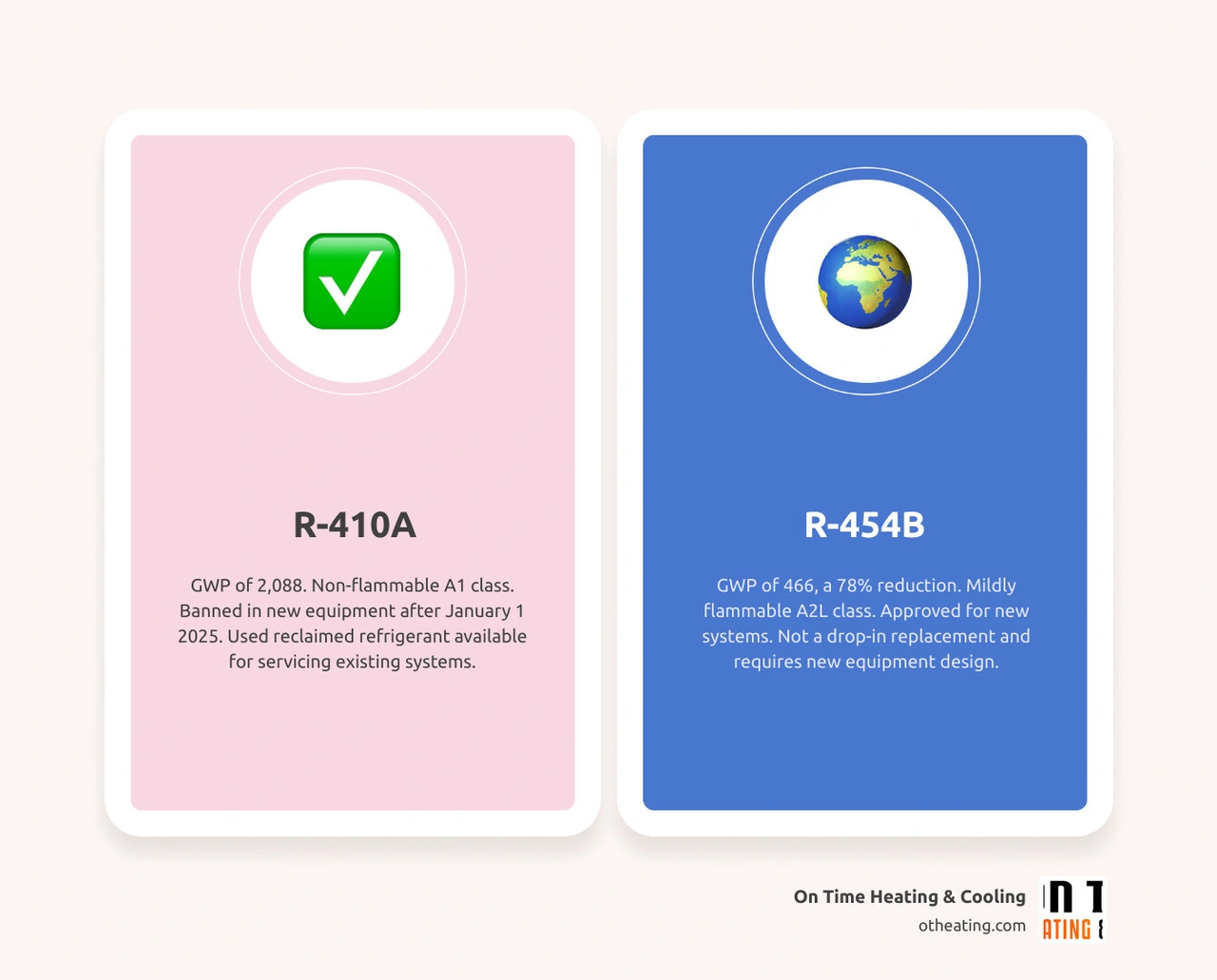
R-410A has a GWP of 2,088, meaning it is more than two thousand times more potent than carbon dioxide when released into the atmosphere. By contrast, R-454B has a GWP of just 466. This represents a massive 78% reduction in direct greenhouse gas impact.
Additionally, R-454B has an atmospheric lifetime of only about 3 years, compared to R-410A’s 17 years. This means that if R-454B does escape through a leak, it breaks down in the atmosphere much faster, minimizing its long-term warming footprint. Both refrigerants have an Ozone Depletion Potential (ODP) of zero, meaning neither poses a threat to the ozone layer. However, R-454B's vastly lower GWP makes it the clear winner for a sustainable future.
The EPA Mandate and the 2025/2026 Cutoff
This transition isn't just a voluntary environmental trend; it is legally mandated. Under the American Innovation and Manufacturing (AIM) Act of 2020, the U.S. Environmental Protection Agency (EPA) was granted the authority to phase down the production and consumption of high-GWP hydrofluorocarbons (HFCs).
The EPA established a strict timeline for residential and light commercial air conditioning systems:
- January 1, 2025: The EPA officially prohibited the manufacture and import of new residential air conditioning and heat pump systems designed to use R-410A.
- The Transition Period: Since that cutoff passed, manufacturers have fully shifted their production lines to low-GWP alternatives, primarily R-454B.
- The Present Day (2026): We are now in a period where new R-410A equipment is no longer being produced, and any remaining warehouse stock of older R-410A systems is rapidly disappearing. If you are purchasing a new central air conditioner or heat pump today, it will almost certainly be designed for R-454B.
R410A vs R454B Refrigerant: What You Need to Know
When comparing r410a vs r454b refrigerant what you need to know comes down to how these chemicals behave inside your air conditioner's closed loop. Fortunately, the engineering behind R-454B was designed to make the transition as seamless as possible for manufacturers, service technicians, and homeowners alike.
To get a better sense of how these changes translate to your monthly utility bills, it helps to review how Efficiency Ratings Explained for Homeowners work under modern SEER2 standards.
Operating Pressures and System Efficiency
One of the greatest engineering challenges in introducing a new refrigerant is managing operating pressures. If a new chemical operated at vastly higher pressures, manufacturers would have to completely redesign compressors, copper tubing, and valves to prevent explosions or rapid wear.
Fortunately, R-454B operates at very similar pressures to R-410A. In fact, under standard operating conditions, R-454B actually runs at a slightly lower high-side pressure (approximately 370 psig compared to R-410A's 400 psig). At identical saturation temperatures, R-454B operates at roughly 5% higher pressure, which is well within the tolerance limits of modern HVAC component designs.
In terms of performance, R-454B is actually more efficient than its predecessor. It delivers:
- Higher Coefficient of Performance (COP): R-454B systems typically achieve a 3% to 5% higher energy efficiency rating than comparable R-410A systems.
- Higher Latent Heat Capacity: R-454B has a 7% higher latent heat capacity, meaning it is more effective at absorbing and releasing heat per pound of refrigerant.
- Better Low-Temperature Performance: For heat pump applications, R-454B maintains 82% of its heating capacity at -15°C (5°F), whereas R-410A drops to 78%. This is a notable benefit for cold Wisconsin winters in areas like Brookfield and Pewaukee.
Coil Design and Temperature Glide
R-454B is a zeotropic blend composed of 68.9% R-32 (a high-efficiency HFC) and 31.1% R-1234yf (a low-GWP hydrofluoroolefin, or HFO). Because it is a blend of two different chemicals with different boiling points, it exhibits a phenomenon known as "temperature glide."
Temperature glide means that as the liquid refrigerant boils and turns into a gas inside the evaporator coil, the different components evaporate at slightly different temperatures. For R-454B, this temperature glide is relatively small — about 1.5°F (1.5°C).
To compensate for this glide and achieve the exact same cooling capacity as an older R-410A system, equipment manufacturers have redesigned their indoor and outdoor coils. R-454B systems require approximately 10% to 20% more heat transfer surface area. This means the coils inside new units are slightly larger or more densely packed with aluminum fins. While this can make the physical cabinets of outdoor condensers slightly bulkier, it ensures optimal heat exchange and prevents energy loss.
Safety and Compatibility: Can You Retrofit Existing Systems?
If you currently have a perfectly functional R-410A air conditioner in your home, you might wonder if you can simply drain the old refrigerant and refill it with the eco-friendly R-454B when a leak occurs.
The short answer is: No, absolutely not.
Attempting to mix these refrigerants or put R-454B into a system designed for R-410A is highly dangerous, will immediately ruin your equipment, and violates federal law. If you suspect your system is losing charge, it is crucial to understand How to Address AC Refrigerant Leaks at Home safely with professional help.
Understanding the A2L Mildly Flammable Classification
The biggest safety distinction between these two chemicals lies in their ASHRAE safety classifications:
- R-410A is classified as A1: This means it has low toxicity and is completely non-flammable under normal operating conditions.
- R-454B is classified as A2L: This means it has low toxicity but is classified as "mildly flammable."
While the word "flammable" can sound alarming to homeowners, the "L" in A2L stands for "low burning velocity." R-454B is incredibly difficult to ignite. It has a high Lower Flammability Limit (LFL) of approximately 11.3% by volume in air. This means you would need a massive, concentrated leak in a very small, sealed room to even reach a combustible mixture.
Furthermore, R-454B requires a very high minimum ignition energy (greater than 1000 mJ) to ignite. Common household ignition sources like static electricity, light switches, or pilot lights do not produce enough energy to light it. It essentially behaves like cooking oil: it can burn if subjected to an intense, sustained flame, but it will not explode or catch fire from a simple spark.
To meet strict safety standards (such as UL 60335-2-40), new R-454B systems come equipped with factory-installed safety features. These include integrated leak detection sensors and mitigation boards. If a leak is detected inside your home's ductwork, the system automatically shuts off the compressor and runs the indoor blower fan to safely disperse the refrigerant long before it can reach a flammable concentration.
Why R-454B is Not a Drop-In Replacement
Because of the chemical and safety differences, R-454B requires entirely purpose-built equipment. You cannot retrofit an old system for several key reasons:
- Lubricant Compatibility: R-410A systems use a standard Polyolester (POE) oil, but R-454B requires a specifically formulated POE oil designed to handle its unique chemical composition and temperature glide.
- Electrical Components: Because R-454B is an A2L refrigerant, all electrical components in the outdoor condenser and indoor air handler must be certified as "spark-proof" or intrinsically safe. Standard R-410A contactors and relays can create tiny electrical arcs during normal operation, which are prohibited in A2L systems.
- Safety Controls: Old R-410A systems lack the specialized leak detection sensors and control boards required by building codes for A2L refrigerants.
- Line Set Considerations: While existing copper refrigerant line sets can often be reused when upgrading to a new system, they must be thoroughly flushed of old oil and pressure-tested. In some cases, R-454B's unique properties require slightly larger suction lines to maintain peak efficiency.
What Homeowners in Southeast Wisconsin Need to Consider
Living in Southeast Wisconsin means dealing with hot, humid summers and freezing winters. Whether you live in Waukesha, Menomonee Falls, Brookfield, or Sussex, keeping your cooling system in top shape is essential. Proper AC Maintenance Keep System Running Smoothly is the best way to extend the lifespan of whatever system you currently own.
Servicing Existing R-410A Systems in 2026
If you own a working R-410A system, there is no need to panic. You are not required by law to replace your air conditioner.
- Reclaimed Supply: Virgin and reclaimed R-410A will remain available to service existing systems for the next 15 to 20 years.
- Rising Service Costs: However, as the EPA phasedown continues to restrict the production of new HFCs, the supply of R-410A is tightening. In 2025, wholesale R-410A prices rose by 40% to 60%, and that trend is continuing.
If your older unit develops a major leak, finding and fixing it early is critical. Relying on professional AC Refrigerant Leak Detection can save you from paying for expensive refrigerant refills. Staying on top of Common AC Problems before they turn into major system failures is the most cost-effective strategy for homeowners in 2026.
r410a vs r454b refrigerant what you need to know for new installations
If you are facing a major system failure in 2026, investing in a new R-454B system is generally the smartest long-term decision.
While some contractors might still have limited, pre-2025 stock of R-410A systems available, installing an outdated system carries risks. You may save slightly on the upfront equipment cost, but you are locking yourself into a refrigerant that will become increasingly expensive to source for future repairs.
Upgrading to an R-454B system future-proofs your home, ensures compliance with all modern environmental standards, and immediately lowers your monthly energy bills thanks to improved SEER2 efficiency. If your current unit is struggling, knowing AC Not Cooling Properly What to Check can help you decide whether a simple repair or a full upgrade to a modern R-454B system is the best path forward.
r410a vs r454b refrigerant what you need to know about system lifespan
A new R-454B air conditioner or heat pump is built to last just as long as older systems — typically 15 to 20 years with regular maintenance.
Because manufacturers have fully embraced R-454B as the primary replacement for R-410A, replacement parts, compatible lubricants, and trained service technicians will be widely available for decades to come. Furthermore, major manufacturers (such as Carrier, Trane, and York) back their new R-454B equipment with robust parts warranties, giving you peace of mind.
If you find yourself troubleshooting why your system is failing, our guide on Why AC Is Blowing Warm Air Troubleshooting Steps can help you identify if a refrigerant issue is the culprit.
Frequently Asked Questions About R-410A and R-454B
Is R-454B safe to have in my home?
Yes, R-454B is completely safe for residential use. While it is classified as an A2L mildly flammable refrigerant, it is exceptionally difficult to ignite in a home setting. It requires a highly concentrated leak (over 11.3% by volume) and a high-energy open flame to burn.
Additionally, modern R-454B systems are built with advanced, factory-installed leak detection sensors and automatic shut-off valves. If a leak is ever detected, the system immediately disables the compressor and runs the indoor fan to safely dilute the gas, preventing it from ever reaching unsafe levels.
Can I still buy R-410A refrigerant for repairs in 2026?
Yes. While the manufacture of new R-410A air conditioning equipment is banned, the refrigerant itself remains legal to purchase and use for servicing existing systems.
A steady supply of reclaimed, recycled, and existing stockpiles of R-410A will remain available for the next 15 to 20 years. However, you should expect the price of R-410A to rise steadily over time as federal production allowances continue to shrink.
Do I need to replace my working R-410A system right now?
No, you do not need to replace a perfectly functional R-410A system. There is no law requiring homeowners to upgrade working equipment.
The best approach is to invest in regular, professional maintenance to keep your system running efficiently and prevent refrigerant leaks. If your older system is reaching the end of its typical 15-to-20-year lifespan and requires a major, costly repair (like a compressor replacement), that is the ideal time to proactively upgrade to a modern, efficient R-454B system.
Conclusion
Navigating the transition from R-410A to R-454B doesn't have to be overwhelming. While the regulations and chemical classifications can seem complicated, the outcome for homeowners is positive: safer, more efficient, and more environmentally friendly home cooling.
At On Time Heating & Cooling, we pride ourselves on blending old-school, punctual customer service with modern HVAC expertise. Whether you are in Menomonee Falls, Waukesha, Brookfield, Sussex, or any of our surrounding Southeast Wisconsin communities, our factory-trained technicians are fully prepared to handle all of your transition needs. From maintaining your existing R-410A unit to installing a brand-new, future-proof R-454B system, we are committed to keeping your home comfortable on time, every time.
Have questions about your home's air conditioner, or want to explore your options for an eco-friendly upgrade? Schedule expert AC service in Waukesha, WI today and let our friendly team guide you through the transition with ease.
Related Articles
 general
Furnace Smells on the First Cold Night: What On Time Heating & Cooling Reviews Say About Our Emergency Response
Read Article general
Troubleshooting Heating and Cooling in Waukesha, WI: The October Furnace Startup Guide
Read Article general
Troubleshooting Fall Heating Startup: What On Time Heating & Cooling Reviews Say About Our Emergency Response
Read ArticleNeed HVAC help?
Whether you need a repair, maintenance, or a new installation, our expert team is here to help.