Everything Homeowners Need to Know About the 2026 Refrigerant Transition
Learn how AC refrigerant changes affect homeowners in 2026: R-410A phase-out, new A2L options, repairs, efficiency & incentives.
Shane Herro
Owner & Lead Tech

Learn how AC refrigerant changes affect homeowners in 2026: R-410A phase-out, new A2L options, repairs, efficiency & incentives.
What the 2026 Refrigerant Transition Means for Homeowners in Menomonee Falls and Southeast Wisconsin
How AC refrigerant changes affect homeowners is one of the most important HVAC questions of 2026, and the short answer is: your existing system is not being shut off, but the rules around what goes inside new ones have shifted significantly.
Here is a quick breakdown of the key impacts:
- Existing systems keep running - If your AC uses R-410A or R-22, you are not required to replace it today
- New equipment uses different refrigerants - Systems manufactured after January 1, 2025 must use lower-GWP alternatives like R-454B (GWP 466) or R-32 (GWP 675), replacing R-410A (GWP 2,088)
- Repairs on older systems get more complex - R-410A supply is tightening as production is phased down, which can affect service availability and timelines
- Retrofitting is rarely possible - Older systems generally cannot be converted to use new refrigerants due to pressure and oil incompatibilities
- Incentives exist to help - Federal tax credits under the Inflation Reduction Act offer up to $600 for qualifying air conditioners and up to $2,000 for heat pumps
- Leaks are now more urgent than ever - With R-410A becoming harder to source, a refrigerant leak in an older system is a bigger deal than it used to be
If you own a home in the Menomonee Falls or greater Southeast Wisconsin area, these changes are already shaping what your options look like the next time your AC needs service or replacement.
The shift is driven by federal regulations under the AIM Act, which directed the EPA to phase down hydrofluorocarbons (HFCs) - a category of refrigerants known for their extremely high global warming potential. The goal is to move the entire HVAC industry toward refrigerants that are significantly less damaging to the climate, even if they require some new safety considerations in how systems are built and installed.
This guide walks through everything you need to know: what the new refrigerants are, whether your current system is affected, how leaks and repairs change under these rules, and when it makes sense to upgrade.
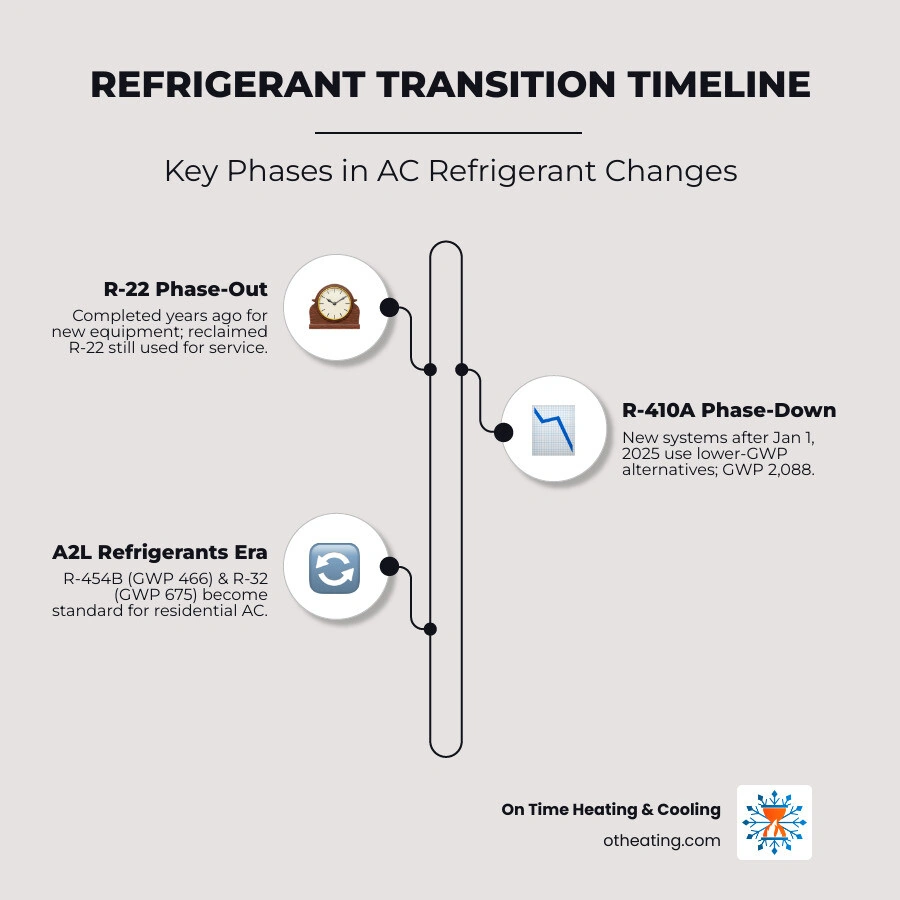
What the 2025 and 2026 refrigerant changes mean for homeowners
The big change is simple: the industry is moving away from higher-GWP refrigerants and toward lower-GWP options in newly manufactured comfort systems.
R-22 was already phased out for new equipment years ago. R-410A then became the standard in residential AC, but it has a very high global warming potential of 2,088. In 2025, newly manufactured residential systems began shifting to lower-GWP refrigerants such as R-454B and R-32. In 2026, homeowners are mostly feeling the practical side of that shift: new system choices, changing repair considerations, and more questions during service calls.
Why these rules are changing now
These rules are happening for environmental reasons. Older refrigerants can do serious damage if released into the atmosphere. The industry has already been through one major transition to move away from ozone-depleting substances, and that effort has had huge public health benefits. Research tied to these long-term phaseouts projects major reductions in skin cancer, cataracts, and related deaths over time.
Now the focus is on reducing climate impact. Compared with R-410A, lower-GWP replacements cut warming impact dramatically. R-454B, for example, has a GWP of 466, and R-32 has a GWP of 675. That is a major improvement over R-410A.
In plain English: the goal is to keep cooling homes while reducing the environmental damage caused by refrigerant leaks and emissions.
How ac refrigerant changes affect homeowners in 2026
For most homeowners, the transition affects decisions more than daily life.
Your current AC does not suddenly stop working because of a regulation change. What changes is:
- Which refrigerants are used in newly manufactured equipment
- How easy older refrigerants are to source over time
- How contractors approach leak repairs
- What replacement options make the most sense
- Which systems may qualify for efficiency incentives
This also ties into energy performance. Many new systems are being redesigned as manufacturers update equipment for the new refrigerants, so homeowners may see improvements in comfort, efficiency, and long-term operation along with the refrigerant change.
Do you need to replace your current system right away?
No. Most homeowners do not need to replace a working R-410A system right away, and the same is true for an R-22 system that is still operating safely and reliably.
That said, there is an important difference between "you do not have to replace it" and "it makes sense to keep it forever."
If your AC is older, has a leak history, struggles in hot weather, or needs major repairs, the refrigerant transition can change the repair-versus-replace conversation. Older R-22 systems are especially important to evaluate carefully, since R-22 has been phased out and usually relies on reclaimed supply. From 2000 to 2018, reclaimers reported recovering more than 140 million pounds of HCFC-22, which shows just how dependent the market has become on reclaimed refrigerant for legacy systems.
New refrigerants replacing R-410A: what R-32 and R-454B mean for your home

R-32 and R-454B are the main lower-GWP refrigerants replacing R-410A in new residential systems. Both fall into the A2L category, which means they are lower toxicity and mildly flammable.
That phrase can sound dramatic, but it helps to keep it in perspective. "Mildly flammable" does not mean "unsafe for homes." It means the systems and installation standards are designed around the properties of the refrigerant, with safeguards built in.
Different manufacturers have chosen different paths, so some new systems are built around R-32 while others use R-454B. The important point for homeowners is that the equipment is engineered specifically for that refrigerant.
How ac refrigerant changes affect homeowners choosing a new AC
If you are replacing your AC in 2026, refrigerant choice matters because each new system is designed as a matched package. You cannot treat refrigerant like a generic refill and swap one type for another.
When choosing a new system, we recommend looking at:
- Refrigerant type
- Efficiency ratings
- Warranty terms
- Long-term serviceability
- Proper sizing for your home
- Whether your ductwork and airflow support the equipment
For homeowners in Waukesha, Menomonee Falls, Brookfield, Sussex, Delafield, Pewaukee, and nearby Southeast Wisconsin communities, that is especially important in older homes where airflow issues can make even a great AC perform like it is having a bad day.
Are A2L refrigerants safe in homes?
Yes, when used in properly designed and properly installed equipment, A2L refrigerants are considered safe for residential use.
The "A" in A2L indicates lower toxicity. The "2L" indicates mild flammability with lower burning velocity than more flammable substances. These refrigerants are being used because they offer a much lower climate impact while still working well in comfort cooling equipment.
Safety depends on the whole system, not just the chemical itself. That includes:
- Equipment designed for the refrigerant
- Installation that follows current codes and manufacturer requirements
- Correct charge levels
- Proper airflow and ventilation where required
- Labeling and service procedures
What safety features new A2L systems include
New A2L systems can include features such as:
- Updated control boards
- Refrigerant sensors in certain applications
- Safety shutoff logic
- Components designed to reduce ignition risk
- Improved labeling on indoor and outdoor units
- Installation instructions specific to the refrigerant
The exact features vary by equipment design, but the bigger point is this: manufacturers did not just pour a new refrigerant into old hardware and hope for the best. These systems were redesigned around the refrigerant and current safety standards.
How the R-410A phase-down affects repairs, leaks, and older systems
As R-410A is phased down, homeowners with older systems may notice that repairs involving refrigerant require more planning. The refrigerant does not vanish overnight, but supply becomes tighter over time.
That matters most when a system develops a leak. Refrigerant is not something your AC "uses up." If levels are low, that usually means refrigerant has escaped from the sealed system.
What happens to repair options for older R-410A and R-22 systems
Older R-410A systems can still be serviced, but leak repairs may become more important because topping off a leaking system becomes a less practical long-term strategy.
For R-22 systems, the challenge is even greater. Since R-22 is phased out, service typically depends on reclaimed refrigerant, and older equipment is usually at a stage where component wear becomes a larger issue too.
In both cases, we encourage homeowners to think beyond the immediate repair and ask:
- Is this the first refrigerant issue or one of several?
- Is the rest of the system in good shape?
- Is the equipment still cooling efficiently?
- Are parts becoming harder to source?
- Will another major repair likely follow soon?
Can older AC systems be retrofitted to new refrigerants?
Usually, no. In most residential situations, older systems cannot simply be retrofitted to use R-32 or R-454B.
Why not?
- Refrigerants operate at different pressures
- Systems use different oils and materials
- Expansion devices and controls are designed for specific refrigerants
- Manufacturer approval is critical
- Safety standards for A2L refrigerants require equipment designed for them
This is why a direct conversion is rarely a realistic option for homeowners. If your current system fails, replacement with a properly matched new system is usually the correct path rather than trying to turn an older unit into something it was never built to be.
Signs of a refrigerant leak homeowners should never ignore
A refrigerant leak is not a "maybe next month" problem. Common warning signs include:
- Warm air from the vents
- Weak airflow
- Ice on the evaporator coil or refrigerant lines
- Hissing or bubbling sounds
- Higher utility bills
- Longer run times
- An AC that never seems to satisfy the thermostat
Low refrigerant can reduce cooling performance, increase energy use, and put added stress on the compressor. It can also allow a relatively small issue to turn into a very expensive one in system wear and downtime.
If you want a deeper look at what leak symptoms mean and what to do next, here are two helpful resources:
Why low refrigerant is never a “top-off only” issue
This is one of the biggest homeowner misconceptions. Your AC is a sealed system. Refrigerant should stay at a consistent level unless there is a leak.
So if someone only adds refrigerant without addressing the source of the leak, that is usually a temporary bandage, not a real fix. The refrigerant can escape again, cooling can drop off again, and the compressor can be damaged from repeated low-charge operation.
The better approach is professional diagnosis, leak confirmation, and then an honest discussion about whether repair or replacement makes more sense.
Energy efficiency, incentives, and smart upgrade timing
The refrigerant transition is not only about environmental rules. It also overlaps with a broader push toward better energy efficiency.
That can be good news for homeowners. ENERGY STAR certified equipment can reduce annual energy bills by more than $160, and many newer ACs and heat pumps are built to deliver more consistent comfort than older systems nearing the end of their life.
How new refrigerants can affect efficiency and utility bills
The refrigerant itself is only part of the story. In many cases, new systems using lower-GWP refrigerants are also newer designs with updated compressors, controls, coils, and efficiency improvements.
That can translate to:
- Lower energy use
- Better humidity control
- More even temperatures
- Quieter operation
- Lower strain during peak summer demand
For homeowners asking how AC refrigerant changes affect homeowners over time, utility savings and fewer breakdowns can be just as important as the refrigerant rule itself.
Rebates, tax credits, and incentives homeowners should check in 2026
If you are considering replacement, do not forget incentives. Depending on the equipment and your eligibility, homeowners may have access to:
- Federal tax credits for qualifying air conditioners
- Federal tax credits for qualifying heat pumps
- Utility rebates
- Manufacturer promotions
- Local or state energy-efficiency programs when available
The federal incentives many homeowners ask about most are:
- Up to $600 for qualifying air conditioners
- Up to $2,000 for qualifying heat pumps
Because programs change, we recommend confirming current requirements before purchase and keeping all documentation for tax and rebate purposes.
When it makes more sense to repair vs. replace
There is no one-size-fits-all answer, but these are useful guidelines.
| Repair may make sense if... | Replacement may make more sense if... |
|---|---|
| Your system is relatively newer | Your system is older and near end of life |
| The issue is isolated and repairable | The system has repeated leaks or major component failures |
| Efficiency and comfort are still good | Utility bills and comfort problems keep getting worse |
| The refrigerant issue is minor and not recurring | The system uses R-22 or has a difficult R-410A leak situation |
| Warranty coverage still helps | You want better efficiency, incentives, and future-ready equipment |
If your AC is aging but still serviceable, we often help homeowners weigh both options carefully instead of rushing into either extreme.
How homeowners in Southeast Wisconsin should prepare now
For homeowners across Menomonee Falls, Waukesha, Hartland, Oconomowoc, Germantown, Mequon, Muskego, New Berlin, and surrounding communities, preparation matters most before the hottest stretch of the season.
The goal is not to panic. It is to avoid getting surprised.
A practical homeowner checklist before your next AC season
Here is a practical checklist we recommend:
- Find your system model and approximate age
- Confirm whether your equipment uses R-22, R-410A, or a newer refrigerant
- Schedule a maintenance visit before peak summer
- Ask about coil condition and any signs of leakage
- Replace or clean air filters regularly
- Check thermostat operation
- Make sure supply and return vents are open and unobstructed
- Ask whether your ductwork or airflow is limiting performance
- Keep maintenance records and repair history
- Save rebate and tax paperwork if you are considering replacement
A little planning now can save a lot of stress when it is 90 degrees and your AC decides it would rather not participate.
Questions to ask before repairing or replacing your system
Before you approve a major repair or replacement, ask:
- What refrigerant does my current system use?
- Is the issue a confirmed leak or another problem?
- If there is a leak, where is it and how severe is it?
- Is this likely to be a one-time repair or part of a larger pattern?
- How much useful life is realistically left in the system?
- What lower-GWP replacement options fit my home?
- What safety features are included with the new equipment?
- Does the replacement qualify for any incentives or tax credits?
- Will my ductwork, electrical setup, and thermostat work with the new system?
These questions help turn a stressful decision into a manageable one.
How ac refrigerant changes affect homeowners in older homes
Older homes in Southeast Wisconsin often come with extra HVAC challenges that go beyond refrigerant alone.
In homes with older ductwork, limited returns, poor insulation, or oversized legacy systems, replacing the AC may be a chance to improve the whole comfort setup. A new refrigerant system can still underperform if airflow is weak or the home loses cooled air too easily.
That is why older homes often benefit from a broader evaluation that looks at:
- Duct condition
- Airflow balance
- Insulation and air leakage
- System sizing
- Thermostat placement
- Overall comfort goals room to room
Conclusion: the best way to stay ahead of the refrigerant transition
The 2026 refrigerant transition is important, but it does not have to be overwhelming. For most homeowners, the right approach is straightforward:
- Keep your current system if it is working well
- Take leaks seriously and address them quickly
- Plan ahead if your system is older or unreliable
- Understand that new equipment will use lower-GWP refrigerants such as R-32 or R-454B
- Look at efficiency improvements and incentives when replacement time comes
At On Time Heating & Cooling, we help homeowners across Menomonee Falls, Waukesha, Brookfield, Sussex, Delafield, Pewaukee, New Berlin, Oconomowoc, and nearby Southeast Wisconsin communities make sense of these changes without the jargon or guesswork. If your AC is leaking, aging, or simply due for a professional opinion, now is a smart time to plan ahead. Our factory-trained technicians provide transparent, fair service, 24/7 emergency support, and free second opinions for diagnostics, and homeowners can also ask about On The Dot Club membership benefits like priority service, discounts, and tune-ups.
For more information about service and support, visit our AC service page.
Related Articles
 Cooling
The Great Spring HVAC Transition: From Toasty to Tasty Cool
Master your spring hvac transition from heating to cooling with our 5-step checklist, DIY tips, and pro maintenance for peak efficiency.
Read Article Cooling
Why Your AC Bill Spikes in Wisconsin Summers
Discover why your AC bill spikes in Wisconsin summers and learn proven ways to cut cooling costs with smart habits and professional maintenance.
Read Article Cooling
The Ultimate Guide to Choosing the Right AC for Your Wisconsin Home
Learn how to choose the right AC for your Wisconsin home with expert tips on systems, sizing, efficiency, and professional installation.
Read ArticleNeed HVAC help?
Whether you need a repair, maintenance, or a new installation, our expert team is here to help.