The Great Spring HVAC Transition: From Toasty to Tasty Cool
Master your spring hvac transition from heating to cooling with our 5-step checklist, DIY tips, and pro maintenance for peak efficiency.
Shane Herro
Owner & Lead Tech

Master your spring hvac transition from heating to cooling with our 5-step checklist, DIY tips, and pro maintenance for peak efficiency.
Why the Spring HVAC Transition from Heating to Cooling Matters for Your Home
The spring hvac transition from heating to cooling is one of the most important maintenance moments of the year for homeowners in Menomonee Falls, WI — and it takes more than just flipping a switch on your thermostat.
Here is a quick overview of the key steps to make the switch safely and efficiently:
- Replace your air filter — a clogged filter from winter heating strains your system
- Clear the outdoor condenser unit — remove debris and ensure at least two feet of clearance around it
- Check and update your thermostat — switch to "Cool" mode, replace batteries, and run a short test cycle
- Inspect vents and ductwork — clean registers and check for leaks that waste conditioned air
- Schedule a professional tune-up — have a technician check refrigerant levels, electrical connections, and the drain line before the heat arrives
Most homeowners assume the seasonal switch is simple. It is not. After a long Wisconsin winter of heavy heating use, your HVAC system needs attention before it is ready to cool your home reliably all summer. Skipping that preparation can mean higher energy bills, poor airflow, or a breakdown on the hottest day of the year — exactly when you need it most.
The good news? A little time and the right steps now can keep your home comfortable and your system running efficiently from spring all the way through summer.

When to Make the Spring HVAC Transition from Heating to Cooling
Living in Southeast Wisconsin, we know that spring weather is anything but predictable. One day you’re wearing a parka in Waukesha, and the next you’re thinking about firing up the grill in Brookfield. Because of these wild swings, timing your spring hvac transition from heating to cooling is an art form.
As we move through April 2026, the general rule of thumb is to wait until daytime temperatures are consistently hitting the mid-70s. If you switch too early during a "fickle" week where it’s 70 degrees at noon but 35 degrees at night, you risk putting unnecessary strain on your system. We recommend a "gradual adjustment" period. Instead of cranking the AC to 68°F the moment the sun comes out, try setting it to 76°F or 78°F first to see how the system responds.
One critical thing to avoid is "short-cycling." This happens when you flip back and forth between heat and cool too quickly. If you’ve been running the furnace on a chilly morning, wait at least three to four hours before switching to the AC. This allows the system’s pressures to equalize and protects your compressor from sudden damage. For more advice on timing your seasonal shift, check out our guide on Spring HVAC System Updates for Homes.
Essential DIY Maintenance for a Seamless Seasonal Switch
Before you ask your air conditioner to do the heavy lifting, there are a few DIY tasks you can handle to ensure a smooth transition. Think of this as a "pre-flight check" for your home’s comfort.
Start with your thermostat. It’s the brain of your HVAC system, and if the brain is fuzzy, the body won’t work. April is the perfect time to replace the batteries in your thermostat, even if they haven't died yet. A weak battery can cause communication breakdowns between the wall unit and the actual AC equipment. While you’re there, calibrate the settings. If you set it to 72°F but the house feels like a sauna, there might be a calibration issue that needs professional eyes.
Next, take a walk through your house and look at your vents and registers. Over the winter, it’s easy for dust to settle or for furniture to get pushed over a vent. Ensure all supply and return registers are completely unobstructed. Wipe them down with a damp cloth to remove any "winter coat" of dust that might otherwise blow into your lungs the moment the fan kicks on. For a deeper dive into keeping things running, see our tips on AC Maintenance Keep System Running Smoothly.
Replacing Air Filters for the Spring HVAC Transition from Heating to Cooling
If the thermostat is the brain, the air filter is the lungs of your system. During a Wisconsin winter, your furnace filter works overtime to trap pet dander, dust, and soot. By the time spring rolls around, that filter is likely "suffocating."
A clogged filter restricts airflow, forcing the blower motor to work harder and increasing your energy bills. We recommend checking your filter every 30 days during the spring hvac transition from heating to cooling. Spring is peak pollen season in areas like Mequon and Germantown, and those tiny particles can clog a filter faster than you’d think.
When choosing a new filter, look at the MERV (Minimum Efficiency Reporting Value) rating. For most residential systems, a MERV rating between 8 and 13 is the "sweet spot"—it provides excellent filtration without being so thick that it chokes the system. If you hold your old filter up to a light and can't see through it, it’s definitely time for an AC Filter Change.
Optimizing Airflow and Ventilation for Better Efficiency
Efficiency isn't just about the machine; it's about how the air moves through your home. One of our favorite "hacks" is the ceiling fan. Most people forget that fans have a seasonal switch of their own.
In the spring and summer, your ceiling fans should rotate counterclockwise. This creates a "wind-chill" effect by pushing a breeze directly down onto you. While it doesn't actually lower the room temperature, it makes you feel cooler, allowing you to set the thermostat a few degrees higher without losing comfort.
Also, keep an eye out for leaky ducts. Research shows that leaky ducts can lose up to 30% of the air passing through them. That is essentially throwing away 30 cents of every dollar you spend on cooling. If you notice certain rooms in your Pewaukee home stay warmer than others, you might be dealing with Fixing Uneven Cooling Issues at Home.
Preparing Your Outdoor Condenser Unit for Peak Performance
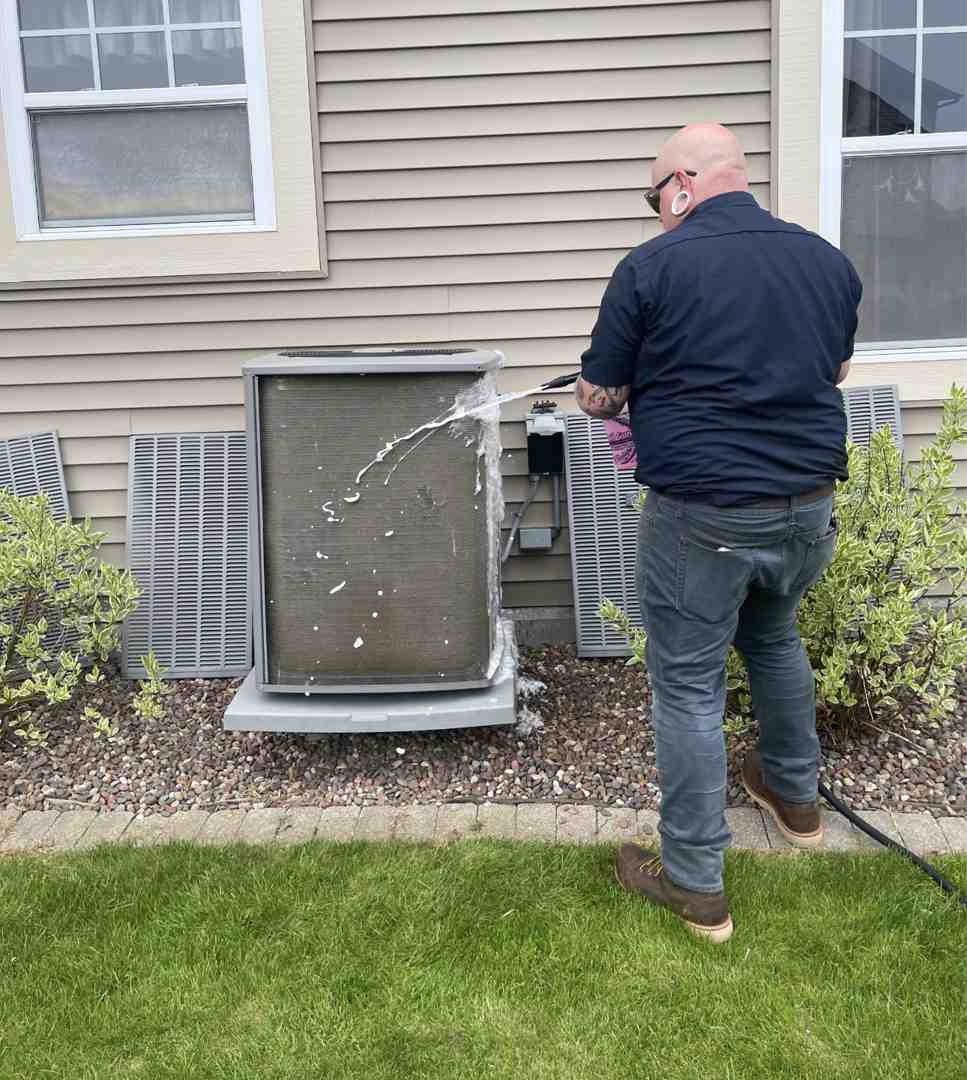
While much of the HVAC system is tucked away in the basement or attic, the outdoor condenser unit is out there braving the elements. After a winter of snow, "winter mulch" (dead leaves), and maybe a few stray branches, that unit needs some TLC.
The most important rule for your outdoor unit is clearance. Your AC needs to "breathe" to release the heat it pulls from your home. Ensure there is at least two feet of open space around the entire unit. This means trimming back any shrubs in your Sussex garden or clearing away tall grass that grew up during the early spring rains.
You can also gently rinse the exterior coils. Dust and cottonwood seeds can act like a blanket, trapping heat inside the unit. Using a standard garden hose, gently spray the coils from the top down. Never use a pressure washer, as the high-pressure stream can bend the delicate aluminum fins and cause permanent damage. For more on outdoor unit care, read our guide on Basic AC Maintenance.
Special Considerations for Heat Pump Systems in Spring
If you have a heat pump in Delafield or Oconomowoc, your spring hvac transition from heating to cooling looks a little different. Unlike a traditional furnace/AC combo, a heat pump works year-round. It doesn't create heat; it moves it.
The most critical part of this transition is the reversing valve. This is the component that tells the refrigerant which way to flow—either bringing heat inside during winter or dumping it outside during summer. Because heat pumps run in both seasons, they experience twice the wear and tear of a standard AC. Industry standards dictate that heat pumps require maintenance twice a year—once before the heating season and once before the cooling season.
If you switch your heat pump to "Cool" and it starts blowing hot air, the reversing valve or its electrical solenoid might be stuck. This is a common issue that we can usually fix quickly, but it does require a professional touch. Check out our specific Heat Pump Maintenance Tips Delafield WI for more localized advice.
Testing Your System During the Spring HVAC Transition from Heating to Cooling
Don't wait for a 90-degree July afternoon to find out your AC is broken. We recommend running a 20-minute test cycle on a mild day in late April.
Set your thermostat about 5 degrees lower than the current room temperature and let it run. While it’s running, be an "HVAC detective."
- Listen: Do you hear rattling, buzzing, or hissing?
- Smell: Is there a musty odor? This is often called "Dirty Sock Syndrome," caused by mold or mildew that grew on the evaporator coils during the winter.
- Feel: Is the air coming out of the vents actually cold?
If you notice the unit starting and stopping every few minutes, it might be short-cycling, which is a major red flag. Sometimes, an AC might even freeze up if the airflow is restricted or the refrigerant is low. If you encounter this, find out Why AC Unit Freezes Up During Spring before you try to run it again.
Why Professional Maintenance is Critical in April 2026
While DIY steps are great, there are things a homeowner simply can't (and shouldn't) do. A professional spring tune-up is like an oil change for your car—it prevents a total engine failure down the road.
When our factory-trained technicians visit your home in New Berlin or Menomonee Falls, we do a deep dive into the system. We check refrigerant levels (which requires specialized gauges), inspect electrical connections for signs of wear or "pitting," and clear out the condensate drain line. A clogged drain line is one of the most common causes of water damage in homes during the summer; if the water has nowhere to go, it backs up into your house.
We also inspect the "capacitors." These are like the batteries that give your AC the "kick" it needs to start up. Worn capacitors are a leading cause of summer breakdowns, and catching a weak one in April can save you from an emergency call in July. For a full breakdown of what a pro does, see our Seasonal AC Tune-Up Guide and Importance and our specific HVAC Maintenance Tips Waukesha WI.
Frequently Asked Questions about Spring HVAC Transitions
When is the best time to switch from heat to AC in Wisconsin?
In Southeast Wisconsin, the "sweet spot" is usually mid-to-late April. Wait until daytime highs are consistently in the 70s. Avoid switching back and forth daily; if the weather is fluctuating, use ceiling fans or open windows to bridge the gap until the warm weather sticks.
Why does my air conditioner smell like mildew when I first turn it on?
This is usually "Dirty Sock Syndrome." It happens when dust and moisture settle on your indoor coils during the winter. A fresh air filter and a professional coil cleaning usually solve the problem. If the smell persists, it could indicate mold in your ductwork or a drainage issue.
How often should I replace my air filters during the spring?
We recommend checking them every 30 days. Because spring brings high pollen counts and "helicopter" seeds from trees in areas like Hartland and Nashotah, filters can clog much faster than they do in the winter. At a minimum, change them every 90 days.
Conclusion
The spring hvac transition from heating to cooling is about more than just comfort—it’s about protecting one of your home’s most expensive investments. By taking a few DIY steps and scheduling a professional check-up, you can ensure your system is ready for whatever the Wisconsin summer throws at us.
At On Time Heating & Cooling, we pride ourselves on our punctuality and our commitment to the Menomonee Falls community. Our factory-trained technicians are experts at spotting the small issues that lead to big repairs. Whether you are in Waukesha, Brookfield, or Mequon, we are here to make sure your transition to summer is a breeze.
Want to take the guesswork out of seasonal maintenance? Join our Maintenance Plan to ensure your system gets the "On The Dot" care it deserves twice a year.
Ready to get started? Schedule your professional spring cooling service today and stay cool all season long!
Related Articles
 Cooling
Why Your AC Bill Spikes in Wisconsin Summers
Discover why your AC bill spikes in Wisconsin summers and learn proven ways to cut cooling costs with smart habits and professional maintenance.
Read Article Cooling
The Ultimate Guide to Choosing the Right AC for Your Wisconsin Home
Learn how to choose the right AC for your Wisconsin home with expert tips on systems, sizing, efficiency, and professional installation.
Read Article Cooling
Everything Homeowners Need to Know About the 2026 Refrigerant Transition
Learn how AC refrigerant changes affect homeowners in 2026: R-410A phase-out, new A2L options, repairs, efficiency & incentives.
Read ArticleNeed HVAC help?
Whether you need a repair, maintenance, or a new installation, our expert team is here to help.