

%202%20(1).svg)
.svg)


The Ultimate Guide to How Clean Ducts Reduce Mold Risk in Your Home
Written by
On Time Heating & Cooling
Published on
June 2, 2026
Why Knowing How Clean Ducts Reduce Mold Risk in Your Home Could Protect Your Family's Health
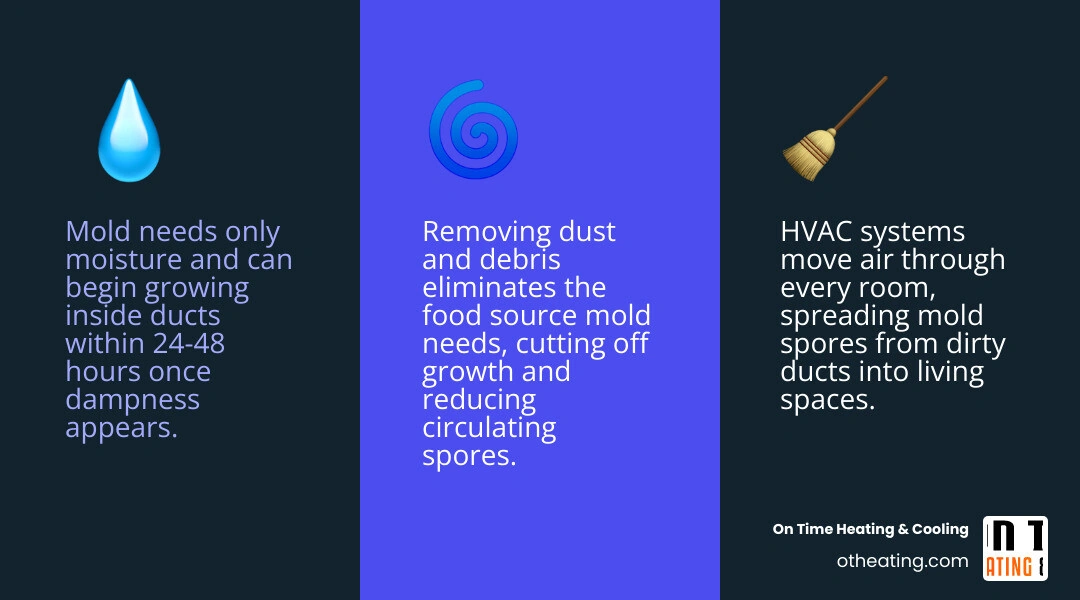
Understanding how clean ducts reduce mold risk in your home starts with one simple fact: your HVAC system moves air through every room, and if mold is hiding inside your ductwork, those spores travel with it.
Here is a quick summary of how clean ducts help keep mold at bay:
- Remove the spore reservoir - Professional duct cleaning physically removes accumulated dust, debris, and mold colonies before they can spread
- Restore proper airflow - Clear ducts prevent the moisture buildup and condensation that mold needs to grow
- Eliminate the food source - Dust and organic debris inside ducts feed mold; removing them cuts off its supply
- Reduce circulating spores - A clean system stops spores from being pushed into living areas every time the fan runs
- Support humidity control - Well-maintained ducts work with your HVAC system to keep indoor humidity in the EPA-recommended 30-50% range
For homeowners in Menomonee Falls, WI, this matters year-round. Wisconsin's humid summers and tightly sealed winter homes both create conditions where moisture can quietly build up inside ductwork. According to the EPA, mold only needs one thing to get started: moisture. And once it finds a damp, dusty duct to settle into, it can begin growing within 24 to 48 hours.
Most homeowners never think about their ducts until something feels wrong — a musty smell when the heat kicks on, allergy symptoms that never quite go away, or dark discoloration around the vents. By that point, mold may already be circulating through the air your family breathes every single day.
Why Mold Thrives in Residential HVAC Systems

To stop mold from taking over your home, we have to look at why it loves HVAC systems in the first place. Your heating and cooling system is essentially the lungs of your home. It pulls air in, conditions it, and pushes it back out. Unfortunately, if conditions are right, it also acts as a perfect incubator for fungal growth.
For mold to grow, it requires four basic elements: mold spores (which are always floating in the air in tiny, invisible numbers), a surface to settle on, oxygen, a food source, and moisture. Your ductwork naturally provides the first three. If we neglect maintenance, we easily provide the last two: organic dust and moisture.
When our cooling systems run during sticky Wisconsin summers in places like Waukesha or Brookfield, warm air meets cold metal ductwork. This temperature differential leads to condensation. If your ducts are already lined with a layer of fine household dust, you have instantly created a damp, nutrient-rich breeding ground. To learn more about the early warning signs of this issue, check out our guide on the Signs of Mold Growth in Your Air Duct System.
How Moisture and Humidity Fuel Fungal Growth
Moisture is the single most critical factor in mold development. Without water, mold spores remain dormant and harmless. However, when warm, humid air cools rapidly inside your ductwork, the air reaches its "dew point" — the temperature at which air can no longer hold its water vapor, turning it into liquid droplets. This process, often called "duct sweating," is especially common in unconditioned spaces like attics, basements, or crawl spaces.
If your crawl space lacks a proper vapor barrier, moisture from the earth constantly rises, raising the relative humidity of the air surrounding your HVAC equipment. The EPA suggests keeping indoor relative humidity below 60%, and ideally between 30% and 50%. When humidity levels climb past 55% to 60%, it activates a high-risk microbial growth environment.
The Role of Dust and Debris as a Food Source
While moisture is the catalyst, mold still needs to eat. Mold cannot feed on bare sheet metal, but it happily devours the organic matter that accumulates inside dirty ducts.
Everyday living generates a surprising amount of airborne debris. Skin cells, pet dander, pollen, hair, carpet fibers, and outdoor dirt get pulled into the return vents. Over time, this debris builds up into a thick, felt-like layer inside your trunk lines.
Not only does this dust act as an all-you-can-eat buffet for fungal spores, but it also restricts airflow. When airflow is restricted, your air conditioner cannot cycle air efficiently. This causes the temperature inside the ductwork to drop even further, worsening condensation and locking in the moisture mold needs to thrive.
How Clean Ducts Reduce Mold Risk in Your Home
So, how exactly does professional cleaning break this cycle? It isn't just about running a vacuum down a vent. True mold risk reduction relies on complete source removal through mechanical agitation and high-powered vacuum containment.
When we clean your ductwork, we use specialized tools like rotating brushes, air whips, and skipper nozzles to physically dislodge the sticky, moisture-holding dust from the duct walls. Simultaneously, we connect a high-efficiency particulate air (HEPA) negative air machine to your system. This powerful vacuum keeps the entire duct network under negative pressure, pulling all loosened debris directly out of your home and preventing spores from escaping into your living spaces.
For a deeper look at how this process works, read about the specialized steps involved in Air Duct Cleaning Mold Removal and explore the details of the professional Air Duct Cleaning Process.
Eliminating the Spore Reservoir: How Clean Ducts Reduce Mold Risk in Your Home
Think of dirty air ducts as a reservoir. If there are mold spores resting in the dust of your trunk lines, every single time your furnace or air conditioner kicks on, it acts like a leaf blower, sending millions of microscopic spores into your bedrooms, kitchen, and living room.
By thoroughly cleaning the system, we strip away the dust layer and any dormant spores resting within it. On non-porous surfaces like bare sheet metal, this process removes the physical foundation mold needs to establish a colony. By keeping these surfaces bare and clean, we ensure that even if temporary condensation occurs, mold has no soil to take root in. Discover the broader benefits of this practice in our article on How Clean Ducts Improve Indoor Air Quality.
Restoring Airflow to Prevent Condensation: How Clean Ducts Reduce Mold Risk in Your Home
A clean duct system is a highly efficient duct system. When dust, pet hair, and old filters clog your system, they create high static pressure. This means your blower motor has to work twice as hard to push air through the home.
When air moves too slowly across your system's cold evaporator coil, the coil can actually freeze, or at the very least, create excessive condensation that drips into the drain pan or leaks into the surrounding supply plenum. By removing airflow restrictions, professional duct cleaning restores balanced system pressure. Air moves swiftly and smoothly, preventing localized cold spots and reducing the "duct sweating" that invites mold. To see how this directly impacts your utility bills and comfort, explore how Air Duct Cleaning Improve Home Air Quality.
Health Risks of HVAC Mold and the Benefits of Cleaning
When mold grows in a hidden corner of your basement, it is a localized problem. But when mold grows inside your air ducts, it becomes a whole-house health hazard. Molds reproduce by releasing tiny, lightweight spores into the air, which can easily be inhaled by anyone in the home.
For sensitive individuals, exposure to these airborne spores can trigger a range of health issues. These include persistent nasal congestion, throat irritation, coughing, wheezing, skin rashes, and severe asthma attacks. Some mold species also produce mycotoxins — toxic compounds that can lead to more severe systemic symptoms, including headaches, chronic fatigue, and sinus infections.
For residents in local communities like Sussex, understanding these risks is the first step toward a healthier home. Read more about How Dirty Air Ducts Impact Health in Sussex and learn about the life-changing Air Duct Cleaning Benefits for Allergy Sufferers.
Recognizing the Signs of Mold in Your Ductwork
Because your ductwork is hidden behind drywall and floorboards, you have to rely on other senses to detect a problem. Keep an eye (and a nose) out for these common warning signs:
- A persistent musty or earthy odor - If you notice a damp, mildew-like smell only when the heating or cooling system is blowing air, mold is likely present in the system.
- Visible dark spotting - Look closely at your supply registers. If you see fuzzy black, grey, or green spots forming on the metal grates or the drywall immediately surrounding the vents, mold spores are likely venting out.
- Unexplained allergy symptoms - If family members experience sneezing, itchy eyes, or congestion that worsens when they are indoors but improves when they leave the house, your indoor air quality is likely compromised.
- Pet scratching and sneezing - Our furry friends are just as sensitive to mold as we are. If your dog or cat is sneezing frequently or scratching persistently without a clear flea or allergy diagnosis, check your vents.
Step-by-Step Guide to Preventing Mold in Your HVAC System
Preventing mold in your HVAC system requires a combination of smart homeowner habits and timely professional service. To help you understand where to focus your efforts, we have broken down the key differences between what you can handle yourself and when you need the pros.
| Maintenance Task | DIY Friendly? | Frequency | Why It Matters |
|---|---|---|---|
| Replacing Air Filters | Yes | Every 1-3 months | Maintains proper airflow and catches organic dust before it enters the ducts. |
| Cleaning Vent Covers | Yes | Every 6 months | Removes surface dust and allows you to inspect vents for moisture or spotting. |
| Monitoring Indoor Humidity | Yes | Constant (via hygrometer) | Helps you keep relative humidity in the safe 30-50% range. |
| Clearing Condensate Drain Lines | Yes / No | Annually | Prevents water from backing up and overflowing into the furnace cabinet. |
| Deep Duct Cleaning & Sanitizing | No | Every 3-5 years | Requires professional HEPA negative air machines and mechanical agitation tools. |
| HVAC System Tune-Ups | No | Twice a year (Spring/Fall) | Ensures coils, blowers, and electrical components are operating efficiently. |
For a complete breakdown of how to care for your home's air distribution system, consult our Air Duct Cleaning Complete Guide.
Best Practices for Homeowners to Control Moisture
To keep your ductwork dry and mold-free, you must manage the moisture levels inside your home. Here are the most effective daily habits to adopt:
- Use exhaust fans consistently - Always run your bathroom exhaust fans during and for 20 minutes after showers, and use your kitchen range hood while cooking. Make sure these fans vent directly to the outdoors, not into your attic or crawl space.
- Invest in a whole-home dehumidifier - If you live in a naturally damp area like Mequon or Cedarburg, a whole-home dehumidifier integrated into your HVAC system can keep your indoor air consistently below 50% relative humidity.
- Inspect your condensate line - Your air conditioner produces gallons of water daily through condensation. Ensure the drain pan is clean and the drain line flows freely. A clog can quickly flood your system and spark rapid mold growth.
- Fix leaks immediately - Roof leaks, plumbing drips, or basement seepage should be dried and repaired within 24 to 48 hours to prevent mold from taking root in nearby building materials.
Professional Maintenance and NADCA Guidelines
When it comes to deep-system cleaning, the National Air Duct Cleaners Association (NADCA) and the Institute of Inspection, Cleaning and Restoration Certification (IICRC) set the gold standards. Under the IICRC S520 standard, mold remediation in HVAC systems requires strict containment protocols to prevent cross-contamination.
During a professional maintenance visit, a certified technician will inspect your entire system, including the evaporator coil, blower motor, and heat exchanger. If mold has penetrated porous insulation materials, like fiberglass duct board or internal duct liners, these materials cannot be effectively cleaned and must be safely replaced. For systems with a history of moisture issues, installing a germicidal UVC light on the evaporator coil can destroy the DNA of mold spores before they can colonize. Learn more about professional standards in our article on Mold Remediation Duct Cleaning.
Frequently Asked Questions About Duct Cleaning and Mold
To help you make the best decisions for your home, we have compiled answers to some of the most common questions we hear from homeowners in Southeast Wisconsin. For more insights on the long-term advantages of clean air pathways, check out our guide on Air Duct Cleaning Benefits for Your Home.
Can I clean mold out of my air ducts myself?
The short answer is no, not for the internal ductwork. While homeowners can safely unscrew register covers, wash them with warm soapy water, and vacuum the first foot or two of the vent openings, you should never attempt to clean deep inside your ducts.
Without professional HEPA-filtered negative pressure machines, any brushing or vacuuming you do with a standard household vacuum will simply dislodge mold spores and send them airborne, spreading the contamination to every room in your house. Furthermore, standard vacuums do not have the filtration capacity to trap microscopic spores, meaning you will blow them right back out of the vacuum exhaust. If you do clean surface-level vent covers, always wear proper personal protective equipment (PPE), including rubber gloves, safety goggles, and an N95 respirator.
How often should air ducts be inspected for mold in Wisconsin?
We recommend having your air ducts professionally inspected every 3 to 5 years. However, you should schedule an inspection sooner if you have recently experienced a water event (such as a roof leak, basement flooding, or plumbing drip), if you are moving into a new home, or if anyone in your household is struggling with unexplained, worsening respiratory symptoms.
In our Southeast Wisconsin service area, our distinct seasonal shifts — from freezing winters to humid summers — mean our systems undergo significant temperature swings that can accelerate condensation issues if left unchecked.
Does bleach kill mold inside ductwork?
No, and you should never use bleach inside your air ducts. While bleach is highly effective at killing surface mold on non-porous materials like bathroom tile, it is highly corrosive to metal ductwork and can damage the zinc coating on galvanized sheet metal.
Additionally, bleach is mostly water; when applied to porous materials like fiberglass duct insulation, the chlorine evaporates quickly, leaving behind water that actually feeds the deep mold roots (hyphae). Finally, running your HVAC system after applying bleach will circulate highly toxic chlorine fumes throughout your entire home. Professional technicians use EPA-registered, HVAC-specific antimicrobials designed to safely sanitize metal surfaces without causing structural damage or dangerous fumes.
Conclusion
When it comes to keeping your home healthy, comfortable, and mold-free, clean air ducts are not a luxury — they are a necessity. By removing the organic dust that acts as food and restoring the balanced airflow that prevents condensation, regular duct maintenance is your best line of defense against hidden mold growth.
At On Time Heating & Cooling, we have spent years helping our neighbors across Southeast Wisconsin breathe easier. From Menomonee Falls and Germantown to Waukesha, Brookfield, New Berlin, and Oconomowoc, our factory-trained technicians are dedicated to keeping your home’s air clean and safe. We pride ourselves on our absolute punctuality, transparent service, and old-school commitment to customer care.
If you are concerned about musty odors, visible dust, or mold risks in your HVAC system, don't wait for the problem to grow. Protect your family's health and restore your system's efficiency today.
Schedule Professional Duct and IAQ Services with the team at On Time Heating & Cooling and experience the peace of mind that comes with truly clean indoor air!
.svg)
.svg)
.svg)
Monday to Sunday:
24/7
24/7
Payments By:

review us on:
©
on time heating & cooling All rights reserved.
Designed & Developed By :
.svg)