Everything You Need to Know About How Seasonal Extremes Affect AC Lifespan
Learn how seasonal extremes affect AC lifespan in Wisconsin and what maintenance keeps your system running reliably through every season.
Shane Herro
Owner & Lead Tech

Learn how seasonal extremes affect AC lifespan in Wisconsin and what maintenance keeps your system running reliably through every season.
Why Seasonal Extremes in Wisconsin Are Quietly Shortening Your AC's Life
Understanding how seasonal extremes affect AC lifespan starts with one simple truth: your air conditioner was not built to handle endless punishment — and Wisconsin's climate delivers plenty of it. From sweltering July heatwaves with high humidity to deep freezes that drop temperatures well below zero, your system cycles through some of the most demanding conditions a residential AC can face. Most homeowners don't realize the damage is already accumulating until the system breaks down on the hottest day of the year.
Here's a quick look at how seasonal extremes cut years off your AC's life:
| Seasonal Extreme | Primary Stress on AC | Typical Lifespan Impact |
|---|---|---|
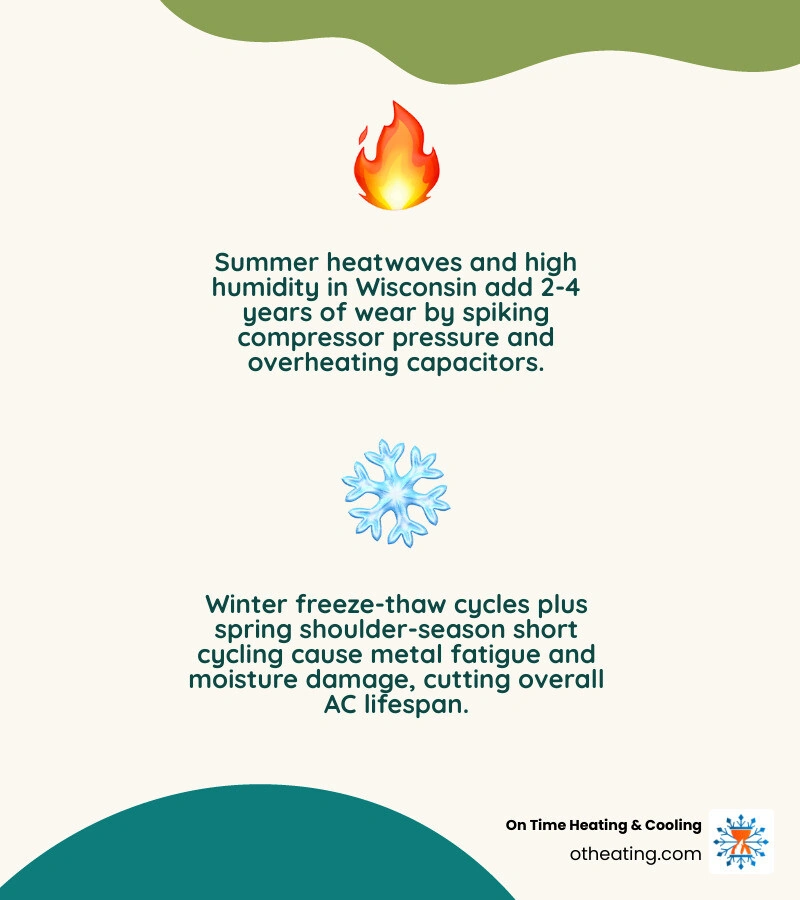
| Summer heatwaves | Compressor overwork, refrigerant pressure spikes, capacitor overheating | Most significant wear; accelerates aging by 2-4 years |
| High summer humidity | Coil strain, moisture buildup, reduced efficiency | Increases degradation rate; raises energy bills |
| Winter freeze-thaw cycles | Metal fatigue, moisture intrusion, debris accumulation | Damages outdoor unit components over time |
| Spring/fall shoulder seasons | Short cycling, inconsistent load, thermostat stress | Causes inefficient operation and premature wear |
Under normal conditions, a well-maintained central air conditioner lasts 15 to 20 years. But in climates with hard seasonal swings — like what homeowners in Menomonee Falls, WI experience every single year — that number can drop significantly without the right care. By the time a system hits year 10, most units are already running at only 80 to 85 percent of their original efficiency, and that gap only widens as seasonal stress continues to build.
The good news? Knowing what's happening inside your system gives you the power to do something about it.
How seasonal extremes affect ac lifespan helpful reading:
How Seasonal Extremes Affect AC Lifespan in Wisconsin
In the Midwest, we often joke that if you don't like the weather, just wait five minutes. While that keeps life interesting, it’s a nightmare for your HVAC system. When we talk about how seasonal extremes affect AC lifespan, we’re looking at the sheer volume of "work hours" the system puts in. In a typical Wisconsin summer, your AC might run for 800 to 1,500 hours. However, when we hit record-breaking 2026 summer temperatures, that runtime can double.
This constant operation leads to component fatigue. Think of it like a car: driving 10,000 miles on a flat highway is much easier on the engine than driving 10,000 miles up a steep mountain in 100-degree heat. For homeowners in Waukesha, Brookfield, and New Berlin, the "mountain" is the extreme humidity and heat spikes that force the compressor to run almost 24/7.
Regional Lifespan Differences
It’s helpful to look at how we compare to other regions. In Texas, AC units typically last only 12 to 15 years because they run for nearly nine months of the year. In cooler states, you might see 15 to 20 years. Wisconsin sits in a unique middle ground. While our cooling season is shorter, our "extremes" are more violent. The transition from a -20°F winter to a 95°F summer creates significant thermal expansion and contraction in the metal components of your outdoor unit, which can lead to refrigerant leaks and structural weakening. You can learn more about local expectations in our guide on how long does an ac last in wisconsin.
The Impact of 2026 Temperature Spikes
As we navigate the current May 2026 season, we are seeing more frequent and prolonged heatwaves. These aren't just uncomfortable; they are mechanically dangerous. When outdoor temperatures exceed 95°F for several days, the electrical stress on your system's motor and capacitors reaches a breaking point. Thermal cycling—the process of components heating up during operation and cooling down rapidly—causes microscopic cracks in solder joints and electrical connections. Over time, this climate-driven aging reduces the long-term durability of even the highest-quality systems. To combat this, we recommend checking out how to extend the life of your ac in the midwest.
The Mechanical Toll of Summer Heatwaves and High Humidity
When the mercury rises, the physics inside your AC unit changes. Extreme heat increases the pressure within your refrigerant lines. This puts an immense strain on the compressor, which is essentially the "heart" of your system. If the refrigerant pressure gets too high, the compressor has to work twice as hard to move heat out of your home. This is often why you might notice your home never quite reaches the set temperature during a heatwave.
Furthermore, high humidity adds "latent heat" to the air. Your AC doesn't just cool the air; it has to remove moisture. In humid areas like Pewaukee and Delafield, the indoor evaporator coil becomes a magnet for dust and grime when it's constantly wet with condensation. If you've noticed your system struggling, it might be showing signs it's time for ac maintenance.
Managing how seasonal extremes affect ac lifespan through summer maintenance
The best defense against summer mechanical failure is simple: airflow.
- Filter Changes: In peak summer, we recommend checking your filter every 30 days. A clogged filter makes the blower motor work harder, leading to overheating.
- Coil Cleaning: Your outdoor condenser coils need to breathe. If they are covered in cottonwood seeds or dirt, the heat can't escape, and your compressor will eventually seize.
- Debris Clearance: Keep at least two feet of space around your outdoor unit.
Scheduling preventative ac maintenance before the first heatwave can prevent a total system meltdown. We’ve found that routine ac maintenance can extend unit life by as much as 3 to 5 years, simply by keeping these mechanical stresses in check. For more tips, see how ac maintenance keep system running smoothly.
Electrical Component Wear
Your AC's electrical system is just as vulnerable as the mechanical parts. Capacitors, which provide the "kick" needed to start the motors, are rated for specific temperatures. On a 95°F day, the inside of your AC's electrical cabinet can reach 150°F. This heat causes the oil inside the capacitor to degrade, leading to failure. Similarly, contactors can become "pitted" or charred during high-demand periods when the system cycles on and off frequently.
Protecting Your System During Winter and Shoulder Seasons
It’s a common misconception that your AC is "safe" just because it’s turned off in the winter. In Wisconsin, the off-season presents its own set of challenges. Freeze-thaw cycles are particularly brutal. When snow melts during a sunny afternoon and refreezes at night, ice can expand inside the fins of your condenser coil, bending the delicate aluminum and reducing future efficiency.
Preparing your system for the spring is vital. We always recommend a spring ac and hvac maintenance check to ensure no critters have chewed through wires or made nests inside the unit over the winter. If you're in the New Berlin area, our ac maintenance guide new berlin wi offers specific local advice for winter recovery.
Minimizing how seasonal extremes affect ac lifespan in the off-season
One of the most debated topics is whether to cover your AC. We recommend using breathable covers. Never wrap your unit in tight plastic or a tarp; this traps moisture, which leads to rust and provides a perfect humid home for rodents. A breathable cover protects the top from falling icicles and debris while allowing air to circulate.
Homeowners in different areas can find tailored advice in our guides, such as the ac maintenance pewaukee wi guide or the ac maintenance guide waukesha wi.
Shoulder Season Cycling
Spring and fall (the "shoulder seasons") bring their own stress: short cycling. This happens when the weather is mild, and your AC turns on and off rapidly because it only needs to drop the temperature by a degree or two. This is incredibly hard on the compressor. To mitigate this, try to use your thermostat effectively—perhaps by widening the "deadband" or using fans on milder days. A seasonal ac tune-up guide and importance can help you navigate these tricky transitional months.
When Weather Stress Leads to Replacement: The Repair vs. Replace Decision
Eventually, the cumulative effect of how seasonal extremes affect AC lifespan will lead to a difficult choice: do you fix the old unit or buy a new one? Many homeowners use the $5,000 Rule: multiply the age of the system by the cost of the repair. If the result is more than $5,000, it’s usually time to replace.
| Factor | Repair | Replace |
|---|---|---|
| System Age | Under 10-12 years | Over 12-15 years |
| Efficiency | 80% or lower | 100% (New SEER2 ratings) |
| Refrigerant | R-410A (available) | New eco-friendly refrigerants |
| Reliability | Likely to break again in heat | 10-year warranty peace of mind |
If your system still uses R-22 Freon (the older, banned refrigerant), repairs can be astronomically expensive. In these cases, it’s almost always better to look at when to consider a full ac system upgrade. If you're seeing signs home needs a new ac system, it's better to act before a summer emergency.
Warning Signs of Climate-Related Failure
How do you know if the weather has finally won the battle?
- Rising Bills: If your energy bills are 20% higher than last May, your system is likely losing its efficiency battle.
- Unusual Noises: Grinding, screeching, or thumping are signs that the compressor or fan motor is nearing its end.
- Weak Airflow: This often indicates a failing blower motor or a refrigerant leak.
For those in our immediate service areas, we have specific resources like the ac replacement waukesha wi page and the ac replacement brookfield wi guide to help you make an informed choice.
Technological Improvements in Modern HVAC
The good news is that modern AC technology is much better at handling how seasonal extremes affect AC lifespan. Newer units often feature variable-speed compressors. Unlike older units that are either "on" or "off," variable-speed systems can ramp up or down. This reduces the stress of starting and stopping, which is where most wear occurs.
Additionally, smart thermostats can now monitor outdoor weather patterns and adjust the system's runtime to prevent overworking. If you are in New Berlin, check our ac replacement new berlin guide to see how these new technologies can actually lower your long-term costs.
Frequently Asked Questions about AC Lifespan
How does extreme heat damage an AC compressor?
The compressor uses oil to lubricate its moving parts. When the system is forced to run in extreme heat with dirty coils, the internal temperatures can rise above 225°F. At this point, the oil begins to break down and turn acidic. This acid eats away at the motor windings, eventually causing a "burnout" or mechanical seizure.
What are the signs of weather-related AC failure?
The most common sign is "short cycling," where the system turns on and off every few minutes. You might also notice a sudden 20% spike in your energy bill, unusual grinding or clicking noises, or "lazy" airflow that feels humid and warm rather than crisp and cold.
How often should I schedule maintenance in Menomonee Falls?
We recommend bi-annual service. Think of it as a "spring pre-flight" to get ready for the heat and a "fall recovery" to clean out the summer's dust and debris. Following basic ac maintenance steps between professional visits can also make a huge difference.
Conclusion
At On Time Heating & Cooling, we understand that your home’s comfort depends on a system that can withstand the worst of Wisconsin’s weather. Whether you are in Menomonee Falls, Waukesha, or Oconomowoc, our commitment to punctuality and factory-trained expertise ensures your AC is ready for whatever 2026 throws at it.
To take the guesswork out of maintenance, consider joining our On The Dot Club. Members enjoy priority scheduling, seasonal tune-ups, and discounts that make keeping your system healthy easier than ever. Don't let the next heatwave be the end of your AC's life.
Related Articles
 Maintenance
Melting the Mystery of Frozen AC Units
Fix ice forming on your ac unit causes and what to do. Learn how to defrost your system and prevent costly damage today.
Read Article Maintenance
How to Stop AC Running Constantly in Wisconsin Heat Waves
Discover why your AC runs constantly during Wisconsin heat waves and learn proven fixes to restore comfort and cut energy costs.
Read Article Maintenance
5 Common AC Repairs and What Causes Them
Discover the most common AC repairs and what causes them in Brookfield WI homes, plus DIY checks and repair-or-replace tips from local pros.
Read ArticleNeed HVAC help?
Whether you need a repair, maintenance, or a new installation, our expert team is here to help.