Duct Cleaning After Construction: Why Your HVAC Needs a Post-Project Spa Day
Discover why duct cleaning after renovation or new construction is essential. Remove construction dust, boost HVAC efficiency, and improve air quality now!
Shane Herro
Owner & Lead Tech

Discover why duct cleaning after renovation or new construction is essential. Remove construction dust, boost HVAC efficiency, and improve air quality now!
What You Need to Know About Duct Cleaning After Renovation or New Construction
Duct cleaning after renovation or new construction is almost always necessary — and here's the short version of why it matters:
Quick Answer:
- Construction generates fine dust (drywall, sawdust, insulation fibers) that standard HVAC filters cannot fully block
- That dust gets pulled into your ductwork every time the system runs during or after a project
- Once inside, it recirculates through your home, irritates airways, and forces your HVAC to work harder
- Even brand-new homes are not exempt — builders often run the HVAC during construction, loading the ducts with debris before you ever move in
- Professional cleaning is the only reliable way to fully clear this type of heavy, fine particulate from inside the system
So the paint is dry, the contractors are gone, and your renovated space looks great. But there's one more thing most homeowners in Menomonee Falls, WI miss before they settle back in: what happened inside the ductwork while all that work was going on.
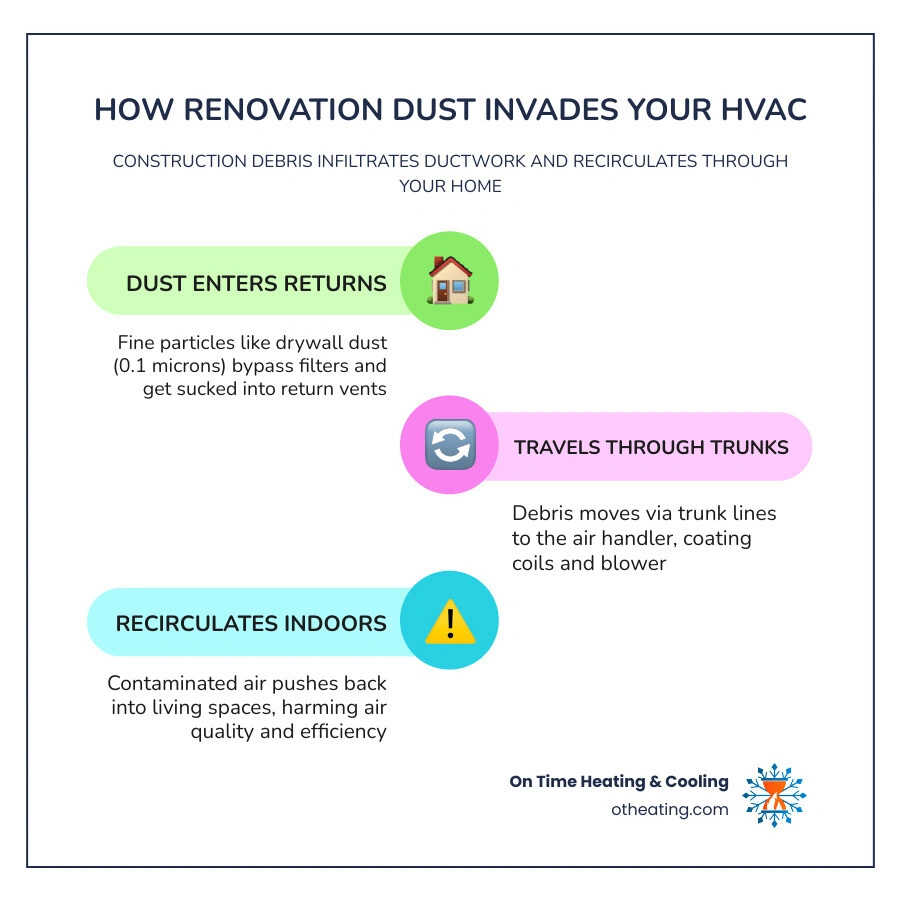
Renovation projects — whether it's a kitchen remodel, a basement finish, or a full new build — kick up enormous amounts of ultra-fine dust. Drywall dust alone can be as small as 0.1 microns, which is small enough to slip right past standard HVAC filters and settle deep inside your duct system. Every time your heating or cooling runs after that, those particles get pushed back into the air you breathe.
It's not just a cleanliness issue. It's a health issue, an efficiency issue, and — if left long enough — a mechanical issue too. The good news is it's fixable. And knowing what you're dealing with is the first step.
Is Duct Cleaning After Renovation or New Construction Really Necessary?
When we talk to homeowners in Waukesha or Brookfield after a big project, the question often comes up: "Do I really need a professional cleaning?" The answer is almost always a resounding yes. Think of your HVAC system as the lungs of your home. During a remodel, those lungs are essentially breathing in a constant stream of "second-hand" construction debris.
This happens because of the HVAC vacuum effect. Your system works by pulling air in through return vents, conditioning it, and pushing it back out through supply vents. If you’ve ever seen a contractor sanding drywall or cutting wood, you know that dust hangs in the air like a thick fog. Even if the system is off, that fine dust settles into the open vents. If the system is running? It’s actively vacuuming those particles straight into the internal components.
From heavy sawdust to microscopic drywall particles, this debris isn't like the "fluffy" household dust you're used to. It's heavy, abrasive, and often chemically active. To understand the full scope of what's hiding in your vents, check out our Post Construction Duct Cleaning insights or dive into our Air Duct Cleaning Complete Guide for a deep dive into the process.
Why New Homes Aren't Exempt from Duct Cleaning After Renovation or New Construction
It’s a common myth that a brand-new home in Sussex or Hartland comes with pristine air ducts. In reality, new construction can be even dirtier than a lived-in home. Why? Because of builder habits.
During the 4-8 week window between installing the ductwork and finishing the registers, those duct "boots" sit open like hungry mouths on the floor or ceiling. Every trade that walks through — from the drywallers to the flooring installers — accidentally drops debris into them. We’ve seen everything from lunch wrappers and soda cans to chunks of insulation and metal shavings inside "new" ducts.
Furthermore, builders often perform HVAC test runs or use the system to regulate temperature while they are still sanding or painting. Since the home isn't "sealed" yet, the system pulls in high volumes of jobsite debris. This is why Duct Cleaning is a vital pre-occupancy step for any new homeowner.
Identifying the Need for Duct Cleaning After Renovation or New Construction in Menomonee Falls
Not sure if your project left a mess behind? Here are the signs we look for when visiting homes in Menomonee Falls and Germantown:
- The "Stony" Odor: When your furnace or AC kicks on, do you smell something like wet concrete or chalk? That’s likely drywall dust sitting on your heating coils.
- Ghost Dust: You clean your coffee table, and 24 hours later, a fine white film has reappeared. This is often "ghost dust" being recirculated from the returns.
- Visual Grit: Remove a vent cover and look inside with a flashlight. If you see piles of sawdust or white powder, your system is compromised.
- Cloudy Bursts: Do you see a faint puff of haze when the blower first starts up? That’s a clear sign of internal contamination.
Maintaining a clean environment is about more than just aesthetics; it's about the Importance Of Regular Air Duct Cleaning to protect your newly renovated investment.
Why Construction Dust is a Nightmare for Your HVAC System
Construction dust is the "supervillain" of the HVAC world. Unlike organic household dust (mostly skin cells and lint), construction debris is inorganic and abrasive. Drywall dust, for example, is made of calcium sulfate dihydrate. When this fine powder meets the condensation on your AC’s evaporator coil, it can form a "cementitious paste." This paste hardens, effectively "bricking" your system's ability to transfer heat.
Many of these particles are as small as 0.1 microns. To put that in perspective, a human hair is about 70 microns wide. These tiny invaders bypass standard filters with ease. Silica dust, a common byproduct of cutting tile or stone, is particularly nasty because it is incredibly sharp and abrasive at a microscopic level.
Standard Household Dust vs. Construction Debris
| Feature | Household Dust | Construction Debris |
|---|---|---|
| Composition | Lint, skin cells, pet dander | Silica, drywall, sawdust, metal shavings |
| Particle Size | 5.0 - 100+ microns | 0.1 - 100 microns |
| Abrasiveness | Low | High (damages motors and bearings) |
| Filter Capture | Most captured by MERV 8 | Often bypasses standard filters |
| Odor | Musty (organic) | Stony, chemical, or "burnt" (inorganic) |
Understanding How Air Duct Cleaning Improves Your Hvac starts with realizing that these abrasive particles act like sandpaper on your system's moving parts.
Health Risks of Lingering Particulate Matter
Living in a home with dirty post-construction ducts is like living in a construction zone long after the contractors have left. The health risks are real, especially for our neighbors in Pewaukee or New Berlin who struggle with allergies.
- Respiratory Triggers: Fine particulates penetrate deep into the lungs, causing coughing, wheezing, and throat irritation.
- Asthma Aggravation: For those with chronic respiratory issues, construction dust can trigger frequent and severe attacks.
- VOCs and Odors: Vapors from new paints, adhesives, and sealants often "hitch a ride" on dust particles, keeping chemical smells alive in your home for months.
- Alkaline Irritation: Drywall dust is highly alkaline, which can irritate the mucous membranes in your nose and eyes.
The Air Duct Cleaning Benefits For Your Home include a drastic reduction in these triggers, giving you the "fresh start" your renovation promised.
Impact on System Performance and Efficiency
Your HVAC system is designed to move a specific volume of air. When dust builds up, it creates air resistance. Research shows that a buildup of just 0.042 inches of dust on a heating or cooling coil can result in a 21% decrease in efficiency.
This means your system has to run longer and work harder to reach the temperature set on your thermostat. This extra strain leads to:
- Mechanical Friction: Abrasive dust gets into the blower motor bearings, causing premature wear.
- Shortened Lifespan: A system that works 20% harder every day will likely fail years sooner than a clean one.
- Higher Bills: You’ll see the impact in your monthly energy costs as the system struggles against the debris.
Investing in the Benefits Of Professional Air Duct Cleaning is essentially an insurance policy for your expensive HVAC equipment.
Professional Source Removal vs. DIY Methods
We often see homeowners in Mequon or Oconomowoc try to tackle post-construction cleanup with a household shop vac. While we admire the DIY spirit, a shop vac simply isn't up to the task.
Professional cleaning relies on Source Removal. This involves two main components: Negative Pressure and Mechanical Agitation. A shop vac might suck up what you can see near the vent, but it lacks the power to pull dust from the 20-foot trunk lines hidden behind your walls. In fact, many household vacuums have filters that aren't fine enough to catch drywall dust, meaning they just suck it up and blow the finest (and most dangerous) particles back out into the room!
Our professional equipment uses high-volume vacuum systems (often truck-mounted) that create a vacuum throughout the entire duct system. While that suction is pulling, we use specialized agitation tools — like air whips and rotary brushes — to dislodge dust that has "glued" itself to the duct walls.
The Professional Post-Construction Cleaning Process
When we perform duct cleaning after renovation or new construction, we follow a rigorous multi-step process to ensure every "nook and cranny" is cleared:
- System Inspection: We use cameras to locate heavy debris deposits and ensure there are no blockages.
- Negative Pressure Setup: We hook our high-powered vacuum to the main trunk line, ensuring all dust is pulled out of the home, not into your living room.
- Trunk Line Cleaning: We clean the large "main" ducts that run through your basement or attic.
- Branch Run Agitation: We go to every individual vent in the house, using compressed air tools to push debris toward the main vacuum.
- Blower and Coil Cleaning: We don't just clean the "pipes." We clean the "engine" (the blower motor) and the "radiator" (the coils) where the most damaging dust settles.
- Final Filter Swap: We finish by installing a fresh, high-quality filter to keep your system protected.
This comprehensive approach is why the Benefits Of Professional Air Duct Cleaning far outweigh any DIY attempt.
Proactive Steps to Minimize Post-Project Debris
If you're planning a project in Delafield or Richfield, you can save yourself a lot of headaches by being proactive. You don't have to let your ducts become a trash can for the construction crew!
- Seal the Vents: Use plastic sheeting or magnetic covers to seal off every supply and return register in the work zone. Don't just use tape; ensure it's a "poly wall" that fine dust can't penetrate.
- System Shutdown: The golden rule of renovation is to turn the HVAC off during active demolition, sanding, or painting. If you need climate control, use portable fans or heaters.
- High-MERV Filters: If you absolutely must run the system, use a filter with a higher MERV rating (around MERV 11) and change it every week during the project.
- Contain the Mess: Encourage contractors to cut materials outside or use "wet sanding" techniques for drywall to keep the dust from becoming airborne in the first place.
By taking these steps, you protect your indoor air quality and ensure that the final Air Duct Cleaning Benefits For Your Home are even more effective.
Frequently Asked Questions
When is the best time to schedule duct cleaning after a renovation?
The best time is after the "final" construction cleanup but before you move your furniture back in or perform your final repainting. You want the heavy dust gone so it doesn't settle on your clean furniture, but you also want to wait until the "messy" phases (sanding and floor finishing) are 100% complete.
Can I clean air ducts myself after construction?
While you can (and should) vacuum out your floor registers and wipe down your vent covers, a full system cleaning requires specialized negative pressure equipment. Standard vacuums lack the agitation tools to reach deep into the system and the filtration to keep microscopic drywall dust from recirculating.
How often should ducts be cleaned after major renovations?
We generally recommend a professional cleaning every 3 to 5 years for a standard home. However, a major renovation is an "acute event." If you've just finished a project, you should have them cleaned regardless of when they were last serviced. This "resets" your maintenance clock.
Conclusion
At On Time Heating & Cooling, we know how much hard work and investment goes into a home renovation. You’ve spent weeks or months picking out the perfect tiles, paint colors, and fixtures for your Menomonee Falls home. Don't let the "invisible" byproduct of that hard work — construction dust — ruin the comfort of your new space.
Our team of factory-trained technicians is committed to punctuality and old-school customer service. We treat your home with the respect it deserves, ensuring that your duct cleaning after renovation or new construction is handled with modern practices and high-powered equipment. Whether you're in Waukesha, Pewaukee, or right here in Menomonee Falls, we're here to help you breathe easier.
Ready to give your HVAC system the "post-project spa day" it deserves? Duct Cleaning is the final step to making your house truly feel like home again. Give us a call today!
Related Articles
 Maintenance
Melting the Mystery of Frozen AC Units
Fix ice forming on your ac unit causes and what to do. Learn how to defrost your system and prevent costly damage today.
Read Article Maintenance
How to Stop AC Running Constantly in Wisconsin Heat Waves
Discover why your AC runs constantly during Wisconsin heat waves and learn proven fixes to restore comfort and cut energy costs.
Read Article Maintenance
5 Common AC Repairs and What Causes Them
Discover the most common AC repairs and what causes them in Brookfield WI homes, plus DIY checks and repair-or-replace tips from local pros.
Read ArticleNeed HVAC help?
Whether you need a repair, maintenance, or a new installation, our expert team is here to help.