The Complete Guide to Best AC Filter Options for Wisconsin Homes
Discover the best AC filter options for Wisconsin homes to improve air quality, protect your HVAC system, and boost seasonal efficiency.
Shane Herro
Owner & Lead Tech

Discover the best AC filter options for Wisconsin homes to improve air quality, protect your HVAC system, and boost seasonal efficiency.
The Best AC Filter Options for Wisconsin Homes, Ranked for Local Conditions
Finding the best ac filter options for Wisconsin homes can feel overwhelming — but it doesn't have to be. Wisconsin's climate is tough on HVAC systems and indoor air quality alike. From heavy spring pollen and humid summers to cold winters that keep your furnace running nonstop, your air filter works harder here than in most parts of the country. Add pets, wood-burning fireplaces, or family members with allergies, and choosing the wrong filter can mean dirtier air, higher energy bills, and a shorter HVAC lifespan.
Here's a quick answer if you need it right now:
Best AC Filter Options for Wisconsin Homes at a Glance
| Household Type | Recommended MERV Rating | Replacement Frequency |
|---|---|---|
| No pets, no allergies | MERV 8 | Every 90 days |
| One pet or mild allergies | MERV 11 | Every 60 days |
| Multiple pets or severe allergies | MERV 11–13 | Every 30 days |
| Asthma, smoke, or wildfire concerns | MERV 13 | Every 30–60 days |
| Older HVAC system | MERV 8–11 | Every 60–90 days |
For most Wisconsin homeowners, a MERV 11 pleated filter hits the sweet spot — strong enough to catch pollen, pet dander, and mold spores without straining your system. But your exact situation matters, and that's what this guide breaks down.
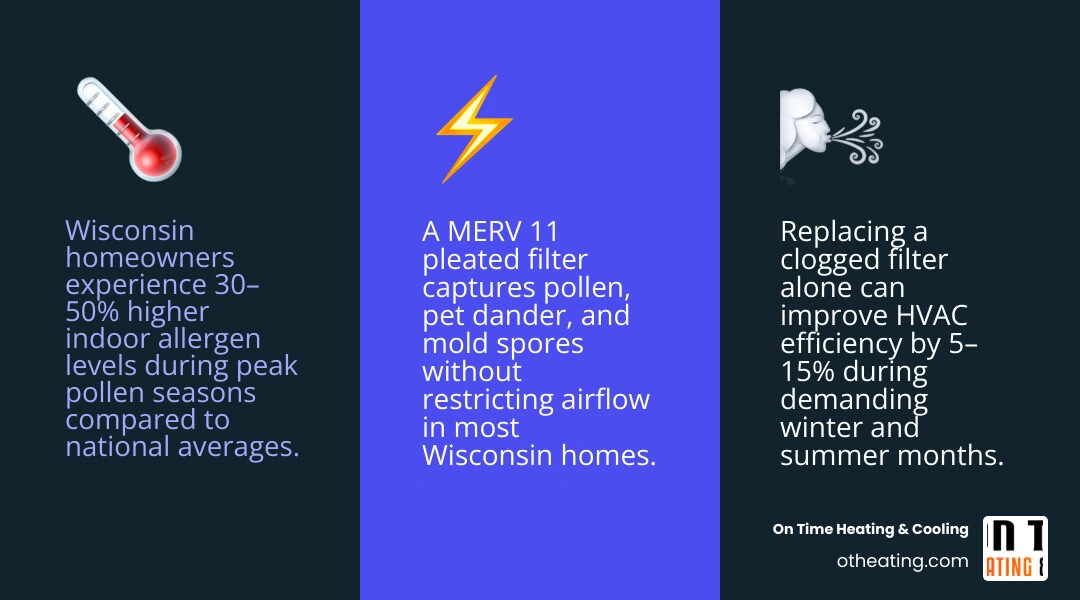
Wisconsin homeowners experience 30–50% higher indoor allergen levels during peak pollen seasons compared to national averages. Replacing a clogged filter alone can improve your HVAC's efficiency by 5–15% — a meaningful difference when your system is running hard through both a cold February and a humid August in Menomonee Falls or Waukesha.
In this guide, we cover filter types, MERV ratings, top brands, sizing, and how often to replace your filter based on real Wisconsin conditions.
Understanding Wisconsin’s Climate and Air Quality Challenges
Living in Southeast Wisconsin means experiencing the full beauty — and the full atmospheric intensity — of all four seasons. While we love our crisp autumns and snowy winters, our local climate poses unique challenges for indoor air quality and HVAC systems.
In the spring, local trees and grasses release massive amounts of pollen. Because of our proximity to Lake Michigan and our lush, wooded landscapes, Wisconsin homeowners experience 30–50% higher indoor allergen levels during peak pollen seasons compared to national averages.
Once summer arrives, high humidity levels sweep across communities like Brookfield and Pewaukee. This moisture creates an ideal breeding ground for dust mites and mold spores. If your air filter isn't up to the task of capturing these microscopic irritants, they will continuously recirculate through your living spaces.
Winter brings its own set of problems. To keep our homes warm during freezing Wisconsin winters, we shut our windows tight, sealing in dust, pet dander, and heating byproducts. Many homes in historic areas like Delafield or Hartland rely on wood-burning fireplaces or stoves, which release fine ash and smoke particles into the indoor air.
Furthermore, in recent years, drifting wildfire smoke from northern forests and agricultural dust from rural areas surrounding Richfield and Slinger have become significant seasonal air quality issues. To protect your family from these fine particles, you need to understand how your air filter behaves across different seasons. For a deeper dive into managing these seasonal shifts, check out our Air Filter Maintenance Guide 2026.
Comparing the Best AC Filter Options for Wisconsin Homes
When shopping for the best ac filter options for Wisconsin homes, you will primarily choose between two main structural styles: flat fiberglass filters and pleated polyester filters.
Fiberglass filters are the inexpensive, see-through filters you often see in bulk packs. They are designed to act as "boulder catchers"—their primary job is to stop large debris, like hairballs and carpet fibers, from damaging your HVAC blower motor. However, they only remove about 20% of particles in the 3.0 to 10.0-micron range. They do almost nothing to capture dust mites, pet dander, mold spores, or fine dust. Because they clog quickly and have very little surface area, they must be replaced every 30 days.
Pleated filters, on the other hand, are made of dense, folded polyester or cotton fibers. The pleats vastly increase the surface area of the filter, allowing it to capture far more contaminants without immediately choking off your system's airflow. High-quality pleated filters often feature an electrostatic charge that acts like a magnet, pulling tiny microscopic pollutants out of the air stream. These filters typically last up to 90 days and are highly effective at trapping the allergens that trigger asthma and seasonal allergies.
Here is a direct comparison of the primary filter types available to local homeowners:
| Filter Feature | Fiberglass Filters | Standard Pleated Filters | High-Efficiency Electrostatic Filters |
|---|---|---|---|
| Average Lifespan | 30 days | 60 to 90 days | 90 days to 6 months (depending on thickness) |
| Particle Capture Rate | ~20% of large particles | ~75% to 90% of medium/large particles | Up to 98% of microscopic particles |
| Protects HVAC Equipment | Yes (basic protection) | Yes (excellent protection) | Yes (excellent protection) |
| Improves Indoor Air Quality | No | Yes (pollen, dust, dander) | Yes (bacteria, smoke, viruses, allergens) |
| Airflow Resistance | Very Low | Low to Moderate | Moderate (requires system compatibility check) |
Evaluating the Best AC Filter Options for Wisconsin Homes by MERV Rating
The industry standard for measuring air filter performance is the MERV rating (Minimum Efficiency Reporting Value). MERV ratings range from 1 to 16 for residential and light commercial systems, with higher numbers indicating tighter filtration.
- MERV 8: This is the baseline filter level we recommend for residential use. A MERV 8 pleated filter captures approximately 90% of particles larger than 3.0 microns, including pollen, dust mites, mold spores, and lint. It provides solid equipment protection and basic air cleaning for homes without pets or severe allergies.
- MERV 11: Considered the residential "sweet spot" for Wisconsin homes, MERV 11 filters capture particles down to 1.0 micron. This includes pet dander, fine dust, automobile emissions, and hair. If you have a cat or dog, or if you suffer from seasonal allergies, upgrading to MERV 11 will dramatically improve your comfort.
- MERV 13: High-efficiency MERV 13 filters are designed to capture particles as small as 0.3 microns. This includes wildfire smoke, tobacco smoke, bacteria, smog, and virus carriers. They are highly recommended for homes near busy roads, areas affected by seasonal smoke, or households with immunocompromised residents.
While higher MERV ratings provide superior air cleaning, they also create more resistance to airflow. If your filter is too dense, your blower motor has to work harder to push air through your home. In older Wisconsin homes with dated ductwork or aging HVAC systems, a MERV 13 filter can restrict airflow so much that it strains the compressor or causes the system to freeze up. To ensure your system is running safely and efficiently, read our guide on Basic AC Maintenance.
Deciphering MERV, FPR, and MPR Ratings for Local Homeowners
When walking down the aisle of a home improvement store in Waukesha, you might notice that not all filters use the MERV scale. This is because different manufacturers and retailers use their own proprietary rating systems:
- MERV (Minimum Efficiency Reporting Value): The universal, independent industry standard developed by ASHRAE. It is the most reliable scale to use when comparing different brands.
- MPR (Microparticle Performance Rating): Created by 3M for their Filtrete brand. It measures a filter’s ability to capture the smallest particles (0.3 to 1.0 microns). For example, an MPR of 1000 corresponds roughly to MERV 11, while an MPR of 1500 to 1900 aligns with MERV 12 or 13.
- FPR (Filter Performance Rating): Developed by The Home Depot. It uses a 1-to-10 scale based on a weighted formula: 60% on large particle capture, 30% on small particle capture, and 10% on the filter's weight gain over its lifespan. An FPR of 5 is comparable to MERV 8, while an FPR of 10 is comparable to MERV 13.
No matter which rating system is printed on the cardboard frame, we recommend prioritizing the MERV scale for an apples-to-apples comparison. If you are unsure which rating your specific system can handle, scheduling professional AC Maintenance Waukesha WI is an excellent way to get an expert assessment of your system’s airflow capacity.
Sizing, Brands, and Sourcing Filters in Southeast Wisconsin
To get the most out of your air filter, it must fit perfectly. If a filter is even a quarter of an inch too small, air will bypass the filter entirely, pulling unfiltered dust and hair directly into your air conditioner’s sensitive internal coils.
Always look at the actual dimensions printed in small text on your current filter frame rather than just the bold nominal size. For example, a nominal 16x25x1 filter might actually measure 15.75" x 24.75" x 0.75".
The most common filter sizes found in local homes include:
- 16x25x1
- 20x25x1
- 20x20x1
- 16x25x5 (common in newer high-efficiency media cabinets)
Several reputable brands manufacture high-quality filters suitable for Wisconsin's seasonal demands:
- Filtrete (by 3M): Widely considered one of the most trusted brands on the market. Their electrostatically charged pleated filters (like the MPR 1000 or MPR 1500) offer excellent particle capture while maintaining reasonable airflow.
- Nordic Pure: Known for producing high-quality pleated filters without a massive retail markup. They offer an excellent range of MERV 12 and MERV 13 options that are highly effective at capturing fine smoke and allergens.
- Filter King: A fantastic option if you need custom-sized filters or want to set up an automatic home delivery subscription so you never forget a filter change.
- Rheem: Offers reliable, basic pleated options that provide great baseline equipment protection for budget-conscious homeowners.
If you live in an older home in New Berlin or Pewaukee, you may have a non-standard filter slot that requires a custom size. Cutting a standard filter to fit is never a good idea, as it ruins the structural integrity of the frame and allows air to bypass the media. For professional assistance with hard-to-find filter sizes or custom installations, check out our localized guides for AC Maintenance Guide New Berlin WI and AC Maintenance Pewaukee WI Guide.
Recommended Filter Replacement Frequency for Wisconsin Seasons
How often should you replace your filter? The honest answer is: it depends on your household. While a standard 1-inch pleated filter can technically last up to 90 days in a quiet, pet-free home, our active Wisconsin seasons often require a tighter schedule.
During peak heating and cooling seasons, your system recirculates air constantly. In the winter, dry indoor air keeps dust suspended, while summer air conditioning pulls high volumes of humid air through the system. If you have pets, their hair and dander will quickly coat the face of the filter, cutting its effective lifespan in half.
For the best balance of indoor air quality and HVAC efficiency, we recommend the following replacement cycles:
- No pets, no allergies: Every 90 days.
- One pet or mild seasonal allergies: Every 60 days.
- Multiple pets, active wood-burning fireplaces, or moderate asthma: Every 30 to 45 days.
- Thicker 4-inch or 5-inch media filters: Every 6 to 9 months (though they should still be inspected every 90 days).
Regularly changing your filter is the easiest way to prevent unexpected breakdowns and keep your utility bills low. If you want to keep your entire cooling system in peak condition ahead of a hot summer, consider booking a professional tune-up. We offer expert services across the region, including AC Maintenance Brookfield WI and AC Maintenance Delafield WI.
How to Choose the Best AC Filter Options for Wisconsin Homes with Pets or Allergies
If your household includes furry family members or anyone dealing with respiratory issues like asthma, choosing the right filter is a matter of daily comfort and health.
Pet hair is relatively easy to capture, but it's the invisible pet dander (microscopic skin flakes) that triggers allergies and lingers in carpets and upholstery. Standard fiberglass filters let these tiny particles pass right through. To manage dander, you need an electrostatically charged pleated filter with a rating of at least MERV 11.
Electrostatic filters are manufactured with fibers that carry a permanent electrical charge. This charge acts like a magnet, pulling dander, pollen, and mold spores out of the air stream and locking them deep within the filter pleats. If you have multiple pets, we highly recommend upgrading to a MERV 13 filter during high-shedding seasons, provided your HVAC system can handle the airflow resistance.
To ensure your home remains a safe haven from outdoor allergens and pet dander, explore our localized maintenance services, such as AC Maintenance Sussex WI and AC Maintenance Mukwonago WI.
Frequently Asked Questions About Wisconsin AC Filters
Can a MERV 13 filter damage my older Wisconsin HVAC system?
Yes, it can if your system isn't designed for it. A MERV 13 filter has incredibly tight pleats to capture microscopic particles. This tight weave creates higher resistance to airflow (known as static pressure). If your older HVAC system has a weaker blower motor or if your ductwork is undersized, a MERV 13 filter can restrict airflow to dangerous levels.
This restriction can cause your system’s evaporator coil to freeze over in the summer or cause your furnace to overheat and short-cycle in the winter. If you want the high-level filtration of a MERV 13 filter but own an older home, have a professional evaluate your system first. For residents in the Lannon area, you can learn more about keeping your system safe by reading our guide on AC Maintenance Lannon WI.
Where can I find custom-sized air filters in Southeast Wisconsin?
Many older or custom-built homes in our area feature non-standard HVAC filter slots. If you cannot find your exact dimensions at a local hardware store, you have a few options. You can order custom-sized filters online through specialized manufacturers like Filter King, or you can work directly with a local HVAC professional.
We can help you source hard-to-find sizes or even retrofit your system with a standard-sized media cabinet to make future filter changes quick and easy. If you are located in the Oconomowoc area, check out our resources on AC Maintenance Oconomowoc WI for local sourcing tips.
How does a dirty filter affect my AC's energy efficiency?
A dirty, clogged air filter acts like a wall in your ductwork. Your air conditioner relies on a steady, continuous flow of warm indoor air passing over the cold evaporator coil to extract heat and moisture. When a filter is coated in dust and pet hair, the blower motor must run longer and work much harder to pull air through.
This extra strain can cause a 5 to 15 percent drop in system efficiency, leading to noticeably higher utility bills. Even worse, the lack of airflow can cause the temperature around the evaporator coil to drop below freezing, turning condensation into a block of ice that completely shuts down your cooling. To keep your system running efficiently all summer long, check out our professional services for AC Maintenance Menomonee Falls WI.
Conclusion
Choosing the best ac filter options for Wisconsin homes is one of the simplest, most cost-effective ways to protect your heating and cooling equipment while keeping your family's indoor air clean and healthy. Whether you need a standard MERV 8 filter for basic dust control, a MERV 11 filter to manage pet dander, or a high-efficiency MERV 13 filter to combat seasonal allergies and smoke, matching the filter to your specific household needs is key.
At On Time Heating & Cooling, based right here in Menomonee Falls, WI, we are dedicated to helping our neighbors stay comfortable in every season. We pride ourselves on our punctuality, blending old-school, friendly customer service with modern HVAC practices. Our strong team environment ensures that every technician who visits your home is highly trained, professional, and ready to treat your system with care.
If you need help selecting the perfect filter, sourcing a hard-to-find size, or preparing your cooling system for the humid summer months ahead, we are here to help. Contact us today to schedule your next tune-up, and let us show you what reliable, on-time service looks like. For our friends in the Pewaukee area, you can easily book your next service by visiting our AC Maintenance Pewaukee WI page. Let's keep your home comfortable, clean, and running efficiently all year long!
Related Articles
 general
What On Time Heating & Cooling Reviews Reveal About Our Waukesha Fall Furnace Startups
Read Article general
Decoding October Furnace Smells: A Guide to Reliable Heating and Cooling in Waukesha, WI
Read Article general
Furnace Smells on the First Cold Night: What On Time Heating & Cooling Reviews Say About Our Emergency Response
Read ArticleNeed HVAC help?
Whether you need a repair, maintenance, or a new installation, our expert team is here to help.